The family of the Prophet ﷺ, his wives, Companions and scholars buried in al-Baqi' in Madinah, and which of their graves can still be placed today.
Author
Muslim Maps
The cemetery of Madinah
Jannat al-Baqi' is the oldest cemetery of Madinah and the most honoured. It lies just south-east of Masjid al-Nabawi, and its older name, Baqi' al-Gharqad, recalls the thorny gharqad shrubs that covered the ground before it became a place of burial.12 Members of the family of Nabi Muhammad ﷺ, most of the Mothers of the Believers and a great many of his Companions are buried here, and the people of Madinah are still laid to rest beside them today.
The first of the Ansar to be buried in al-Baqi' was As'ad ibn Zurarah, who passed away in 1 AH while Masjid al-Nabawi was being built. The first of the Muhajirun was Uthman ibn Maz'un, who passed away soon after Badr.34 The Prophet ﷺ carried a heavy stone himself and set it at the head of Uthman's grave to mark it, saying that he would bury the members of his family who passed away beside him.5 When his infant son Ibrahim passed away, he was buried there, and from then on each of the clans of Madinah set aside a part of al-Baqi' for its own dead.1
The Prophet ﷺ used to go out to al-Baqi' at the end of the night. Sayyida Aishah reported that he would greet the believers buried there and ask Allah to forgive the people of Baqi' al-Gharqad.6 Visitors still come to greet them in the same way.
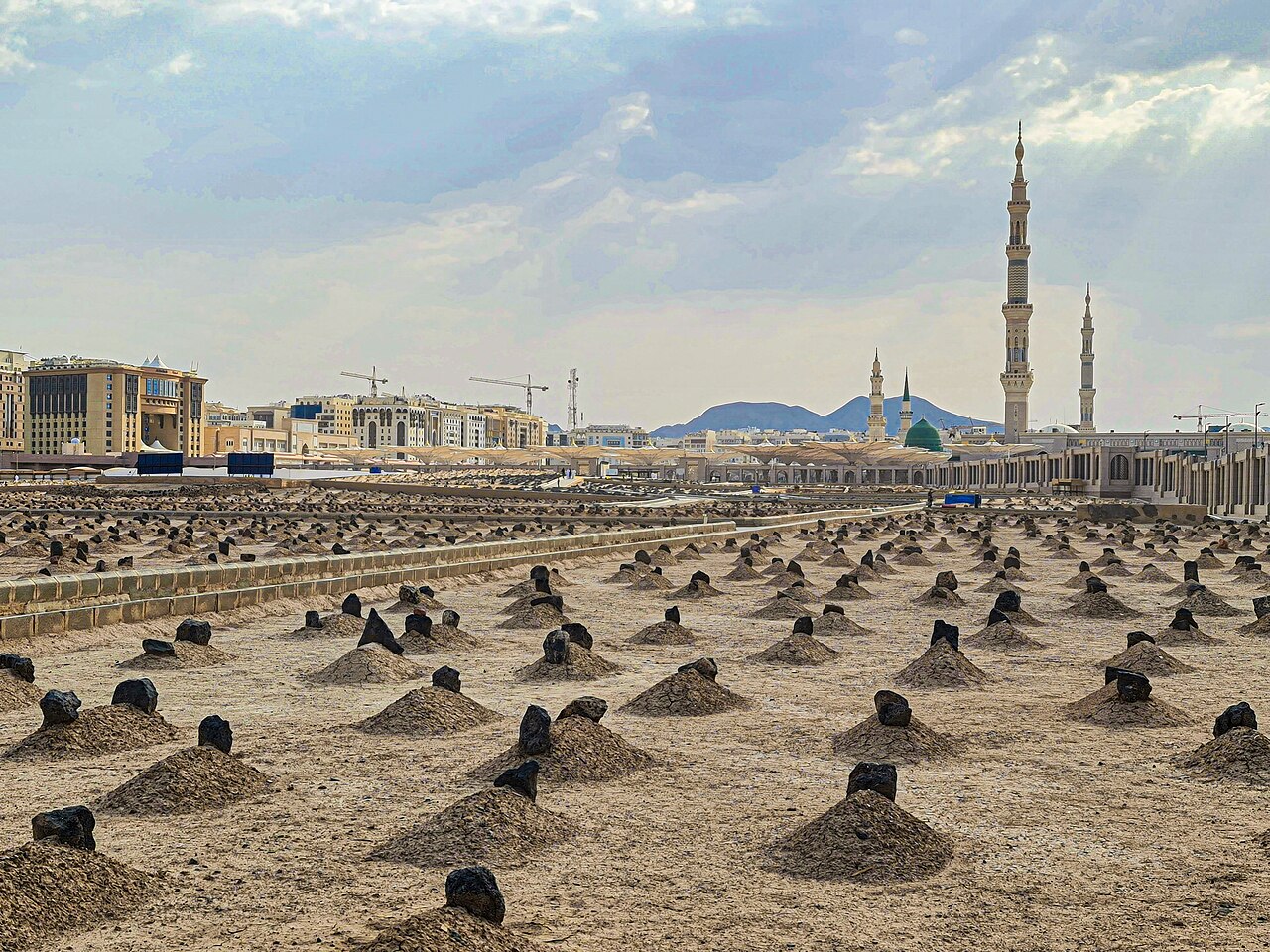
Jannat al-Baqi' in 2021. Photo: Saleh Al Hussain, CC BY 4.0, via Wikimedia Commons
What we know and what we do not
Over the centuries domes and tomb buildings were raised over the best-known graves. A dome with two doors was built over the graves of Sayyiduna al-Hasan ibn Ali and Sayyiduna al-Abbas in 529 AH (1135), and another over the grave of Sayyiduna Uthman ibn Affan in 601 AH (1205). Ottoman travellers described the graves covered in green cloth embroidered with gold, and the air scented with aloeswood.1 The buildings were taken down in 1806, rebuilt in the Ottoman period and removed again in 1926. Since then the graves have been level with the ground and marked only by low stones, without names.12
Knowing who lies where therefore depends on what was written down before the names were lost. The historians of Madinah described the graves by their place beside landmarks such as the house of Aqil ibn Abi Talib. Umar ibn Shabbah (d. 262 AH) is the earliest of them, and Nur al-Din al-Samhudi (d. 911 AH) gathered their reports in his history of Madinah, Wafa' al-Wafa'.7 The domes stood over the graves of the family of the Prophet ﷺ and of the leading Companions for centuries, and the Ottoman General Staff's map of Madinah of 1297 AH (1880) records the cemetery as it was then.8
Adnan Şensoy has brought these sources together on a map of al-Baqi' with 88 graves and sites. For 38 of them he ties the position to the Ottoman map or to 360-degree photographs taken at the spot, and Muslim Maps uses his positions for its listings in al-Baqi'. For 43 others, all people recorded as buried in al-Baqi', he draws an outline and labels it as the place of those who passed away in Madinah and whose place in al-Baqi' is not known.8
The names below fall into three groups. Some graves are shown today in a known place, recorded by the historians and marked on the old maps. Many more people are recorded as buried in al-Baqi', but where they lie within it was not written down. And some are honoured in more than one place, because the sources preserve more than one account of where they were laid to rest; these accounts are given here as the tradition gives them. No list can name everyone buried in al-Baqi'. These lists give the people named by the historians and encyclopaedias in the references, and on Adnan Şensoy's map.
Al-Baqi' before 1926, with the domes over the graves of the family of the Prophet ﷺ. Photo: public domain, via Wikimedia Commons
The family of Nabi Muhammad ﷺ
The family of Nabi Muhammad ﷺ are buried together near the entrance of al-Baqi', in and around the area of the old house of Aqil ibn Abi Talib. His son Ibrahim lies a short way further in, beside Uthman ibn Maz'un, as the Prophet ﷺ had said.158
These graves of the family are shown today:
Sayyiduna Ibrahim, the son of the Prophet ﷺ and Sayyida Mariyah, who passed away as an infant in 10 AH. He lies beside Uthman ibn Maz'un. See Grave of Ibrahim ibn Muhammad ﷺ.
Sayyida Ruqayyah (d. 2 AH), Sayyida Zaynab (d. 8 AH) and Sayyida Umm Kulthum (d. 9 AH), the daughters of the Prophet ﷺ. See Graves of Zaynab, Ruqayyah & Umm Kulthum.
Sayyida Fatimah al-Zahra, the daughter of the Prophet ﷺ (d. 11 AH). Many of the historians of Madinah place her grave here, in the enclosure near the entrance, while others hold that she was buried in her own house beside the mosque. See Graves of Fatimah, Hasan & Abbas and our guide Where Is Sayyida Fatimah al-Zahra Buried?
Sayyiduna al-Abbas ibn Abd al-Muttalib, the uncle of the Prophet ﷺ (d. 32 AH), and Sayyiduna al-Hasan ibn Ali, his grandson (d. 49 or 50 AH), in the same enclosure. See Graves of Fatimah, Hasan & Abbas.
Sayyida Safiyyah bint Abd al-Muttalib (d. 20 AH) and Sayyida Atikah bint Abd al-Muttalib, the aunts of the Prophet ﷺ. See Graves of Atikah & Safiyyah.
Sayyida Fatimah bint Asad, the mother of Sayyiduna Ali, who cared for the Prophet ﷺ as a mother when he was a boy (d. about 4 AH). See Grave of Fatimah bint Asad.
Sayyiduna Aqil ibn Abi Talib, the cousin of the Prophet ﷺ, who passed away in the time of Mu'awiyah or soon after. See Grave of Aqil ibn Abi Talib.
Sayyiduna Abdullah ibn Ja'far, the son of Ja'far ibn Abi Talib and husband of Sayyida Zaynab bint Ali (d. 80 AH). See Grave of Abdullah ibn Ja'far.
Sayyiduna Abu Sufyan ibn al-Harith, the cousin and foster brother of the Prophet ﷺ (d. 20 AH). See Grave of Abu Sufyan ibn al-Harith.
These members of the family are recorded as buried in al-Baqi', but their place within it was not written down:
Sayyiduna Nawfal ibn al-Harith ibn Abd al-Muttalib, the cousin of the Prophet ﷺ (d. 15 AH).
Sayyiduna Muhammad ibn al-Hanafiyyah, the son of Sayyiduna Ali (d. 81 AH). A grave in his name is also honoured in Cairo; see Grave of Muhammad ibn al-Hanafiyya.
The graves of Sayyiduna al-Abbas, Sayyiduna al-Hasan and the Imams of the family of the Prophet ﷺ. Photo: مانفی, CC BY-SA 4.0, via Wikimedia Commons
The Mothers of the Believers
The wives of the Prophet ﷺ who passed away in Madinah are buried together in one enclosure near the entrance of al-Baqi', close to the graves of his daughters and of Aqil ibn Abi Talib.18 See Graves of the Wives of Nabi Muhammad ﷺ.
These are the wives buried together in the enclosure:
Sayyida Zaynab bint Khuzaymah (d. 4 AH), known as the Mother of the Poor.
Sayyida Zaynab bint Jahsh (d. 20 AH).
Sayyida Sawdah bint Zam'ah, one of the first women to accept Islam (d. 22 or 54 AH).
Sayyida Umm Habibah bint Abi Sufyan (d. 44 AH).
Sayyida Hafsah bint Umar (d. 45 AH).
Sayyida Safiyyah bint Huyayy (d. 50 AH).
Sayyida Juwayriyah bint al-Harith (d. 56 AH).
Sayyida Aishah bint Abi Bakr (d. 58 AH).
Sayyida Umm Salamah Hind bint Abi Umayyah (d. 62 AH).
Two others are recorded as buried in al-Baqi', though their place within it was not written down:
Sayyida Mariyah al-Qibtiyyah, the mother of Sayyiduna Ibrahim (d. 16 AH).12
A great many Companions were buried in al-Baqi', but the place of only a few of their graves was recorded. Most of those shown today lie in three places: near the entrance with the family of the Prophet ﷺ, around the grave of Sayyiduna Ibrahim a short way in, and at the far eastern side, where Sayyiduna Uthman ibn Affan and Sa'd ibn Mu'adh are buried.8
These graves of the Companions are shown today:
Sayyiduna Uthman ibn Affan, the third caliph (d. 35 AH), at the eastern side of the cemetery, in ground that lay just outside al-Baqi' at the time and was later joined to it.2 See Grave of Uthman ibn Affan.
Halimah al-Sa'diyyah, the foster mother of the Prophet ﷺ, at the eastern side of the cemetery. See Grave of Halimah al-Sa'diyyah.
Ubayy ibn Ka'b, the master of the Qur'an reciters, whose grave is associated with the site of his clan's mosque at the western edge of al-Baqi'. See Site of Masjid Ubayy ibn Ka'b.
These Companions are recorded as buried in al-Baqi', but their place within it was not written down:
Al-Bara' ibn Ma'rur, a leader of the Ansar at the second pledge of al-Aqabah, who passed away shortly before the Hijra.
Abu Salamah ibn Abd al-Asad, the first husband of Sayyida Umm Salamah (d. 4 AH).
Amrah bint Mas'ud, the mother of Sa'd ibn Ubadah (d. 5 AH).
Usayd ibn Hudayr, a leader of the Aws (d. 20 AH).
Umm Ayman, who cared for the Prophet ﷺ as a child (d. about 24 AH).10
Abdullah ibn Zayd, who saw the words of the adhan in a dream (d. 32 AH).
Al-Miqdad ibn Amr (d. 33 AH).
Abu Talhah al-Ansari (d. 34 AH).
Abu Abs ibn Jabr, who fought at Badr (d. 34 AH).
Arwa bint Kurayz, the mother of Sayyiduna Uthman ibn Affan.
Suhayb al-Rumi (d. 38 AH).
Khawwat ibn Jubayr (d. about 40 AH).
Abu Rafi', the freed slave of the Prophet ﷺ (d. about 40 AH).
Rifa'ah ibn Rafi', who fought at Badr (d. 42 AH).
Muhammad ibn Maslamah (d. 43 AH).
Abdullah ibn Salam (d. 43 AH).
Zayd ibn Thabit, the scribe of the revelation (d. 45 AH).2
Sa'id ibn Zayd, one of the ten promised Paradise (d. 51 AH).
Hassan ibn Thabit, the poet of the Prophet ﷺ (d. 54 AH).2 A maqam in his name is also honoured in Syria; see Maqam of Hassan ibn Thabit.
Hakim ibn Hizam, the nephew of Sayyida Khadijah (d. 54 AH).2
Sa'd ibn Abi Waqqas, one of the ten promised Paradise and the last of the Muhajirun to pass away, who was carried to al-Baqi' from his land at al-Aqiq (d. 55 AH).11
Al-Arqam ibn Abi al-Arqam, in whose house the first Muslims of Makkah met (d. 55 AH).
Sa'id ibn al-As, governor of Madinah and of Kufa (d. 59 AH).
Jabir ibn Abdullah, one of the last of the Companions in Madinah (d. 78 AH).2
Abdullah ibn al-Arqam, who wrote letters for the Prophet ﷺ.
Abdullah ibn Ayyash.
Nusaybah bint Ka'b, known as Umm Umarah, who fought at Uhud.2
Adnan Şensoy's map also marks a spot for the graves of Sa'd ibn Abi Waqqas and Amrah bint Mas'ud, but without giving its source, so they are listed here until the position can be checked. Most of the others in this list are among those he places inside his outline for burials whose place is not known, and the rest are named in the encyclopaedias in the references.8 The dates follow the years most often given; for several Companions the sources differ by a year or two.
The grave of Sayyiduna Ibrahim, among the graves of the early Companions. Photo: مانفی, CC BY-SA 4.0, via Wikimedia Commons
Scholars, rulers and later generations
Al-Baqi' has remained the cemetery of Madinah, and in every century since the Companions it has received scholars, Sufis and rulers who passed away in the city, some of them brought from far away to be buried here.1 Only a few of their graves can be placed today.
These graves are shown today:
Imam Malik ibn Anas, the imam of Madinah and founder of the Maliki school (d. 179 AH). See Grave of Imam Malik ibn Anas.
Imam Nafi', whose grave is shown beside that of Imam Malik. Some take it to be the grave of Nafi' al-Madani, the reciter of Madinah (d. 169 AH), and others that of Nafi', the freed slave of Abdullah ibn Umar and teacher of Imam Malik (d. 117 AH). See Grave of Imam Nafi' al-Madani.
Abdulmecid II, the last Ottoman caliph, who died in Paris in 1944 and was buried in al-Baqi' on 30 March 1954.12 See Grave of Caliph Abdulmecid II.
Muhyi al-Din Mehmed of Akhisar, known as Münşî, shaykh of Masjid al-Nabawi and author of a commentary on the Qur'an (d. 1001 AH).14
Al-Banuri, the Sufi shaykh from the Punjab in India (d. 1053 AH).15
Dervish Abdi Mevlevi, the Ottoman calligrapher, who spent the rest of his life in Madinah (d. 1057 AH).16
Ahmad al-Qushashi, the Sufi scholar of Madinah (d. 1071 AH).
Ahmad ibn Muhammad al-Banna, the scholar of the Qur'an readings from Dumyat (d. 1117 AH).
Muhammad al-Samman, the shaykh from whom the Sammaniyyah takes its name (d. 1189 AH).
Ahmad al-Sawi, the Maliki scholar from Egypt (d. 1241 AH).
Ahmad al-Ahsa'i, the scholar from al-Ahsa (d. 1241 AH).9
Muhammad Abid al-Sindhi, the scholar of hadith (d. 1257 AH).
Ziver Pasha, the Ottoman statesman and poet, who passed away in 1862 while serving as shaykh of the Haram in Madinah.17
Imam Shamil, the leader of the Muslims of Daghestan and Chechnya in the Caucasus, who passed away in Madinah in 1871.
Ali Riza Kashikchi, the Naqshbandi poet from Konya (d. 1969).18
Muhammad al-Ghazali, the Egyptian scholar (d. 1996).
Abd al-Fattah Abu Ghuddah, the Syrian scholar of hadith (d. 1997).
Ali Ulvi Kurucu, the Turkish poet and writer (d. 2002).
Muhammad Ali al-Amri, a scholar of Madinah (d. 2011).9
Haydar Hatipoğlu, a Turkish teacher.
Hafiz Abd al-Hasib, a student from Kazan.
Adnan Şensoy marks spots for the graves of al-Samhudi, Ziver Pasha, Imam Shamil and Haydar Hatipoğlu, and for the gravestone of Hafiz Abd al-Hasib, without giving their source. Most of the others in this list are among those he places inside his outline for burials whose place is not known, and the rest are named in the encyclopaedias in the references.8
Other sites in al-Baqi'
Bayt al-Ahzan, the House of Sorrows, where Sayyida Fatimah is said to have come to mourn her father ﷺ. See Site of Bayt al-Ahzan.
Masjid Ubayy ibn Ka'b, the mosque of the Banu Judaylah at the western edge of al-Baqi', where the Prophet ﷺ is reported to have prayed. See Site of Masjid Ubayy ibn Ka'b.
The graves of the people of Madinah who were killed at al-Harrah in 63 AH, many of them sons of the Muhajirun and Ansar. See Graves of the Martyrs of Harrah.
Bab al-Jumu'ah, the old gate of the city wall that opened onto al-Baqi', which Adnan Şensoy also marks.8
The grave of Sayyiduna Uthman ibn Affan. Photo: مانفی, CC BY-SA 4.0, via Wikimedia Commons
Visiting al-Baqi'
Al-Baqi' lies immediately south-east of Masjid al-Nabawi, across the open plaza from the mosque's eastern side. Men can usually enter for a short time after Fajr and after Asr, while women generally view the cemetery from outside the walls.
Inside, paths run between the graves, which are level with the ground and carry no names, so it helps to know the layout before you go. The family of the Prophet ﷺ and his wives lie just inside the entrance, Sayyiduna Ibrahim and the early Companions a short way further in, and Sayyiduna Uthman ibn Affan, Halimah al-Sa'diyyah and Sa'd ibn Mu'adh towards the eastern side. The listings linked below show each grave on the map.
Al-Baqi' and Masjid al-Nabawi. Photo: Kerina yin, CC0, via Wikimedia Commons
Nur al-Din Ali ibn Ahmad al-Samhudi (d. 911 AH), Wafa' al-Wafa' bi-Akhbar Dar al-Mustafa, which gathers the reports of Umar ibn Shabbah (d. 262 AH) and the earlier historians of Madinah