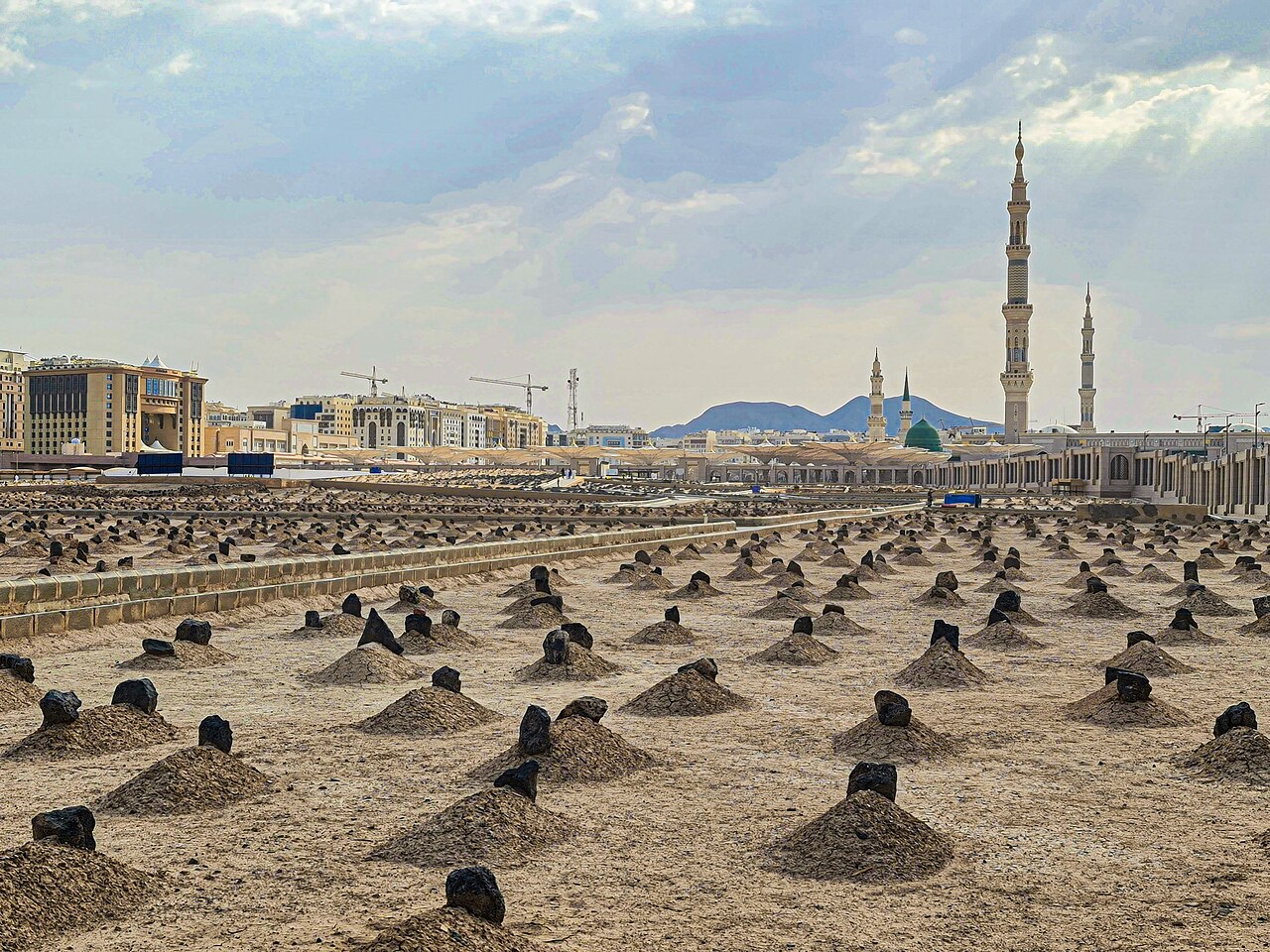
Sa'd ibn Mu'adh ibn al-Nu'man al-Ansari (RA), chief of the Aws, died of his wounds in 5 AH / 627 CE, weeks after the Battle of the Trench, and is buried in…
Sa'd ibn Mu'adh ibn al-Nu'man al-Ansari (RA), chief of the Aws, died of his wounds in 5 AH / 627 CE, weeks after the Battle of the Trench, and is buried in Baqi' Graveyard in Madinah. He was in his mid-thirties. No Companion's death is described in the hadith literature in quite the same terms as his. The chief who brought his tribe in Before the hijrah, Mus'ab ibn Umayr (RA) was sent to Madinah to teach the small number who had accepted Islam. Sa'd came upon him in a gathering, spear in hand, intending to drive him out. Mus'ab answered him calmly: sit and listen, and if you dislike what you hear I will leave. Sa'd sat, listened, and accepted Islam on the spot. He then stood before Banu Abd al-Ashhal, his own subtribe, and told them plainly that speaking with any of them was forbidden to him — man or woman — until they believed in Allah and His Messenger ﷺ. By the end of that day, it is reported, there was not a man or woman of the subtribe who had not entered Islam. That single conversion opened Madinah's most powerful clan to the Prophet ﷺ before he arrived in it. Badr and the Trench At Badr, when the Prophet ﷺ sought the view of the Ansar before the fighting — since their pledge at Aqabah had been to protect him in Madinah, not to march out — it was Sa'd who answered for them, telling him to go forward with whatever he had decided, and that if he crossed the sea they would cross it with him. In 5 AH, during the siege of the Trench, an arrow struck him in the arm and cut the median vein. The Prophet ﷺ had a tent pitched for him in the mosque so he could visit him closely while the wound was treated. The judgement on Banu Qurayzah Banu Qurayzah had entered a treaty of mutual defence with the Muslims of Madinah and broke it during the siege, siding with the confederate armies of Quraysh at the most dangerous moment. When the siege lifted, the Muslims besieged them, and after some days they asked that Sa'd decide their case — he had been their ally in the days before Islam. Wounded and carried in, he gave his ruling under the terms of the treaty they had themselves broken. Both sides had agreed in advance to accept whatever he decided. His death and the shaking of the throne His wound reopened after the judgement and he died of it. The Prophet ﷺ described what met him in words the Companions never forgot. The throne of the Most Merciful shook at the death of Sa'd ibn Mu'adh. Sahih al-Bukhari 3803 Scholars have explained the shaking as an expression of the honour of his arrival rather than a movement of the throne itself. It is also reported that seventy thousand angels attended his funeral, and that the Prophet ﷺ said the grave presses every person once, and that Sa'd received that pressing and was then released from it. The grave He is buried in Baqi', on the eastern side of the graveyard, the ground level and unmarked as it is throughout Baqi'.
This site is located within Jannat al-Baqi Graveyard.