
The 638 CE covenant of Umar ibn al-Khattab guaranteed Jerusalem's people, churches and crosses — and why he prayed outside the Holy Sepulchre.
Before Jerusalem was a chapter of Muslim history, it was already part of our faith. It is the land of Masjid al-Aqsa, the place our beloved Prophet Muhammad ﷺ was carried to on the night of al-Isra, where he led all of the anbiya, peace be upon them, in prayer. It was also the first qibla of the Muslims, the direction our community faced before the Ka'ba.
So when the Sahaba came to Jerusalem in 17 AH / 638 CE, they were not arriving at an unknown city. They were arriving at a sanctuary the Prophet ﷺ had described to them, held at that time under Byzantine Christian rule.
What happened next is remembered not for a battle but for a written promise. The assurance given by Sayyiduna Umar ibn al-Khattab (RA) protected the lives, property and churches of the people of Jerusalem, and set the tone for how the city would be governed for centuries.
The Treaty of Umar and the opening of Jerusalem
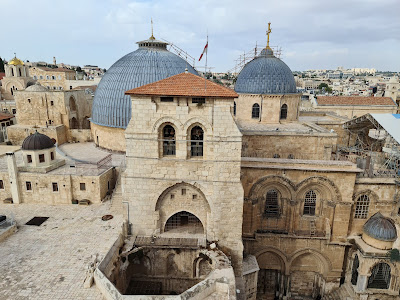
Jerusalem was then a Byzantine city known officially as Aelia. Its most prominent building was the Church of the Holy Sepulchre, and the city's life revolved around churches, monasteries and pilgrim lodgings.
The generation before the conquest had been brutal for its people. In 614 CE the Sasanian Persians took the city with heavy violence and destruction, and Byzantine rule only returned under Heraclius in 629 CE. Communities were treated harshly during those swings of power, and Jewish presence in the city had long been restricted under Byzantine government.
By the time Muslim armies reached Palestine, both empires were exhausted. After the decisive victory at Yarmouk in 15 AH / 636 CE, Byzantine authority in the region collapsed quickly. Jerusalem was surrounded, but the Sahaba did not storm it. Negotiations were opened instead, and its Patriarch, Sophronius, asked that the surrender be accepted by the Caliph himself.
The campaign in Sham was led by companions whose names are familiar to anyone who has read the Seerah. They had prayed behind the Prophet ﷺ in Madinah, and now they stood at the gates of the first qibla.
Abu Ubayda ibn al-Jarrah (RA) held overall command in Sham and oversaw the siege of the city. Khalid ibn al-Walid (RA), the commander at Yarmouk, and Amr ibn al-As (RA), who led the campaign across Palestine, were both present, as were Abd al-Rahman ibn Awf (RA) and Mu'awiya ibn Abi Sufyan (RA). All four are named at the foot of the covenant as witnesses. The Patriarch of the city, however, asked that the surrender be received by the Caliph in person, so Sayyiduna Umar ibn al-Khattab (RA) came from Madinah himself.
Sayyiduna Umar (RA) travelled from Madinah to Palestine to accept the surrender in person. The accounts of his arrival are remembered for their simplicity: the ruler of a rapidly expanding state entered one of the most contested cities on earth without imperial display, and met the Patriarch as a man responsible before Allah for those now under his care.
What he gave the city was not a speech but a written guarantee, addressed to its people and binding on those who came after him.
The contrast with the years before is stark. Under the Byzantines and, before them, the Persian sack of 614 CE, Jerusalem had known massacre, reprisal and exclusion. The Muslim opening of the city passed without a massacre, without looting and without a single church being seized. The Patriarch stayed in office, the liturgy continued, and no community was expelled.
Sayyiduna Umar (RA) is remembered for going to Masjid al-Aqsa, which had been used for dumping rubbish under Byzantine rule, and clearing it with his own hands before praying there. The place the Prophet ﷺ had been taken to on the night of al-Isra wal-Mi'raj was restored to dignity, and Masjid al-Aqsa returned to being a house of prayer.
Jews, who had been barred from living in Jerusalem for centuries under Byzantine law, were permitted to return and settle in the city. Christians kept their churches and their crosses. In the space of a single agreement, a city that had changed hands violently twice in one generation changed hands again, and the lives of the people living in it were left intact.
That peace outlived the generation that wrote it. Since the time of Sultan Salahuddin al-Ayyubi, after Jerusalem returned to Muslim rule in 583 AH / 1187 CE, the key of the Church of the Holy Sepulchre has been entrusted to two Muslim families of the city, the Nuseibeh and the Joudeh. Every morning a Muslim still unlocks the doors of Christianity's holiest church, and every evening he locks them again. Centuries on, the essence of the covenant is still being fulfilled by hand.
The most repeated story of the visit takes place at the Church of the Holy Sepulchre. Patriarch Sophronius is said to have shown Sayyiduna Umar (RA) around the church and when the time for salah came he invited him to pray inside.
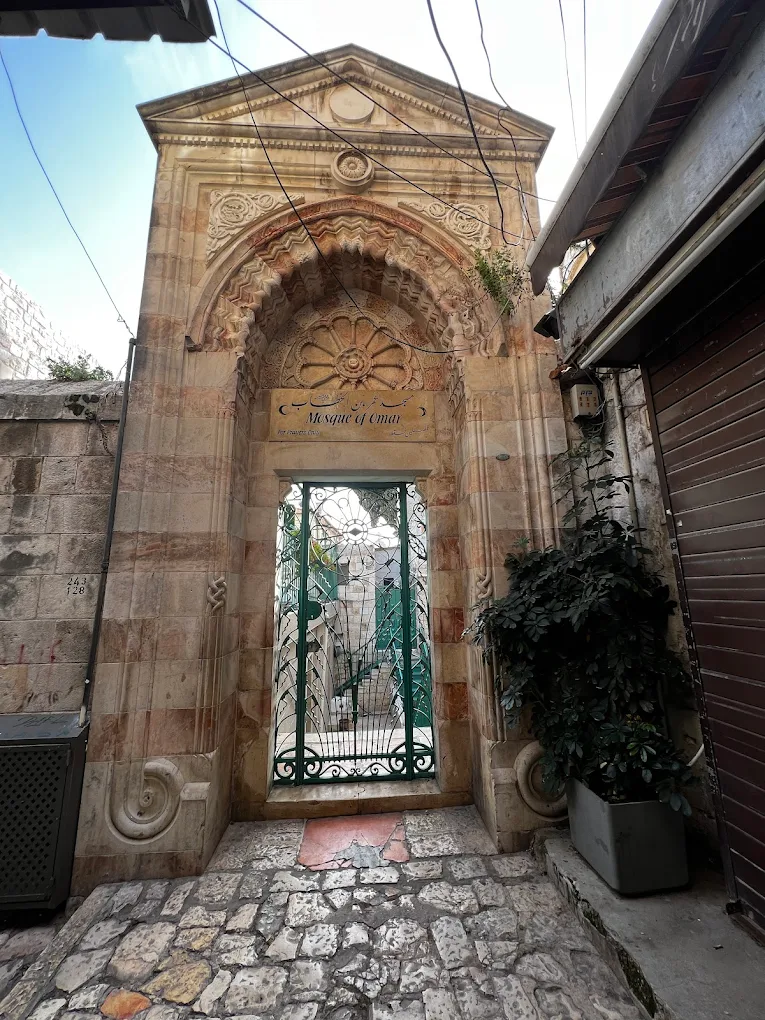
Umar declined and prayed outside instead. He explained that if he prayed within the church, Muslims after him might use his action as grounds to turn the building into a masjid. By stepping outside, he protected the church for the community that had just been given a written promise.
It is a small act, but it is the covenant made visible. The document spoke of security for churches; the Caliph then refused to do the one thing that might have quietly undone it.