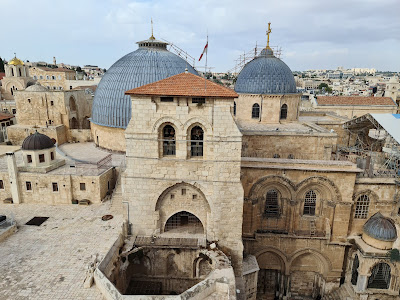
Standing in the Christian Quarter of Jerusalem's Old City, the Church of the Holy Sepulchre — known in Arabic as Kanisat al-Qiyamah , the Church of the…
Standing in the Christian Quarter of Jerusalem's Old City, the Church of the Holy Sepulchre — known in Arabic as Kanisat al-Qiyamah , the Church of the Resurrection — is one of the oldest and most visited places of worship in the world. For Muslims it is also a landmark of a promise: the guarantee of protection given to the Christians of Jerusalem by Sayyiduna Umar ibn al-Khattab رضي الله عنه when the city was peacefully surrendered to him in 638 CE (17 AH). The Umari Covenant According to the well-known account preserved by Muslim and Christian chroniclers alike, Patriarch Sophronius invited Sayyiduna Umar رضي الله عنه to pray inside the church. He declined, and prayed outside instead, explaining that if he prayed within, later Muslims might claim the building as a mosque and take it from its people. The small Mosque of Umar stands opposite the church's courtyard as a reminder of that refusal. The terms he issued, remembered as al-Uhda al-Umariyya (the Umari Covenant), guaranteed the safety of the city's churches, crosses and inhabitants. What the church marks The church encloses the sites that Christian tradition identifies with the crucifixion and burial of Sayyiduna Isa عليه السلام, honoured in Islam as one of the mighty prophets of Allah. Muslims and Christians understand what happened here very differently, and the building remains a place to approach with adab and quiet respect. A layered survivor The original basilica was built in the 4th century under Constantine, destroyed and rebuilt more than once, and substantially reshaped by the Crusaders in the 12th century. After Sultan Salahuddin al-Ayyubi رحمه الله recovered Jerusalem in 1187 CE (583 AH), he restored the church to the Christian communities and reaffirmed protections for pilgrims, following the precedent set by Sayyiduna Umar رضي الله عنه. The Muslim families who hold the keys One detail keeps that history alive daily: the keys to the church have been entrusted to two Muslim Jerusalemite families for centuries — the Nusaybah family, who open and close the doors, and the Joudeh family, who hold custody of the key. The arrangement, upheld through Ayyubid, Mamluk, Ottoman and modern rule, exists because the Christian denominations sharing the building could not agree on a single custodian. It is a quiet, living piece of Jerusalem's Muslim stewardship, still performed every morning before dawn. Visiting today The church sits a short walk from Bab al-Khalil (Jaffa Gate) and from al-Masjid al-Aqsa, deep in the alleys of the Old City. Entry is free and it is open daily, though hours shift with the seasons and with the liturgical calendar. Modest dress is required, shoulders and knees covered, and quiet is expected — parts of the building are in near-constant use for prayer by the resident communities.