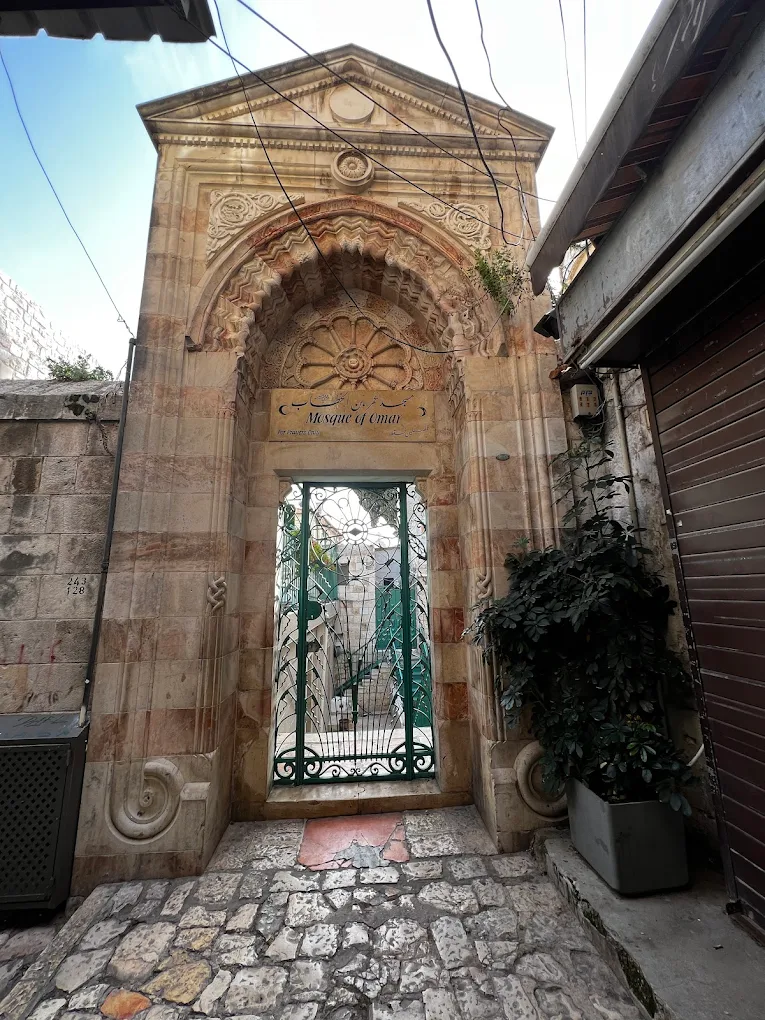
Masjid Umar ibn al-Khattab marks the place where Sayyiduna Umar ibn al-Khattab (RA) prayed outside the Church of the Holy Sepulchre. Known in Arabic as مسجد…
Masjid Umar ibn al-Khattab marks the place where Sayyiduna Umar ibn al-Khattab (RA) prayed outside the Church of the Holy Sepulchre. Known in Arabic as مسجد عمر بن الخطاب, the mosque faces the church’s courtyard in Jerusalem’s Old City. Its history joins the peaceful surrender of Bayt al-Maqdis to Sayyiduna Umar ibn al-Khattab (RA) with the city’s recovery by Salahuddin al-Ayubi more than five centuries later. The prayer of Sayyiduna Umar Sayyiduna Umar ibn al-Khattab (RA), the second caliph and a leading Companion of the Prophet Muhammad ﷺ, travelled from Madinah to receive Jerusalem during the Muslim conquest of Palestine in 16 AH/637–638 CE. He granted the people of the city security for their lives, property, churches and crosses in the agreement remembered as the Umari Assurance. Jerusalem’s historical tradition holds that Patriarch Sophronius accompanied Sayyiduna Umar ibn al-Khattab (RA) through the city and invited him to pray inside the Church of the Holy Sepulchre. Sayyiduna Umar ibn al-Khattab (RA) declined and prayed outside, explaining that a prayer within the church might later be used by Muslims as grounds to take it from its community. The mosque commemorates that prayer. The episode is preserved in the later account of the Muslim historian Ibn Khaldun, who relates that Sayyiduna Umar ibn al-Khattab (RA) prayed on the steps outside and took measures to prevent the place from being turned into a congregational Muslim prayer site. The mosque built by al-Malik al-Afdal The present mosque was founded in 589 AH/1193 CE by al-Malik al-Afdal Abu al-Hasan Ali, son of Salahuddin al-Ayubi. Its construction followed Salahuddin al-Ayubi’s recovery of Jerusalem in 583 AH/1187 CE and established a permanent mosque at the place associated with the caliph’s prayer. A foundation inscription now positioned above the mihrab records that al-Malik al-Afdal ordered the mosque’s construction. The building is consequently also known as the Mosque of al-Malik al-Afdal Ali ibn Salahuddin al-Ayubi. The prayer hall is entered through a courtyard and is covered by intersecting vaults supported internally by columns. Its square minaret was completed in 870 AH/1465 CE, during the Mamluk period. Work was later undertaken during the reign of the Ottoman Sultan Abdulmecid I in the nineteenth century. A mosque beside the Holy Sepulchre The mosque stands in the Christian Quarter, directly south of the Church of the Holy Sepulchre and overlooking its courtyard. Records of Jerusalem’s Islamic court preserve references to the mosque, its location and members of Jerusalemite families who held its appointed offices. Its position preserves the connection between two moments in Jerusalem’s history: the assurance issued by Sayyiduna Umar ibn al-Khattab (RA) when he received the city, and the mosque commissioned by the son of Salahuddin al-Ayubi after Jerusalem returned to Muslim rule.