Why two Muslim families, the Joudeh and the Nusaybah, have held the key and opened the door of Christianity's holiest church in Jerusalem since 1187 CE.
In the Christian Quarter of Jerusalem's Old City stands the Church of the Holy Sepulchre, known in Arabic as Kanisat al-Qiyamah, the Church of the Resurrection. It is the most visited church in the world, and each morning it stays shut until two Muslim families arrive to open it.
The key is iron, roughly thirty centimetres long, and it is kept in the home of the Joudeh al-Ghudayya family. The Nusaybah family have been entrusted with the door of the church since the seventh century. Neither household is Christian, and neither owns any part of the building, which is precisely why the responsibility rests with them.
Six Christian denominations hold rights inside the church, each with its own defined spaces and responsibilities. Placing the door under any one of them could be seen as giving that community control over access for the others. Instead, the opening and closing are entrusted to two Muslim families who stand outside those arrangements. The arrangement in its present form dates to Sultan Salahuddin al-Ayyubi in 1187 CE, and rests on a promise given a good deal earlier than that.
Jerusalem came under Muslim rule in 17 AH / 638 CE without a battle for the city. Its Patriarch, Sophronius, negotiated the surrender and asked that it be received by the Caliph in person, so Sayyiduna Umar ibn al-Khattab (RA), a Companion of the Prophet Muhammad ﷺ and the second Caliph of Islam, travelled from Madinah to accept it himself.
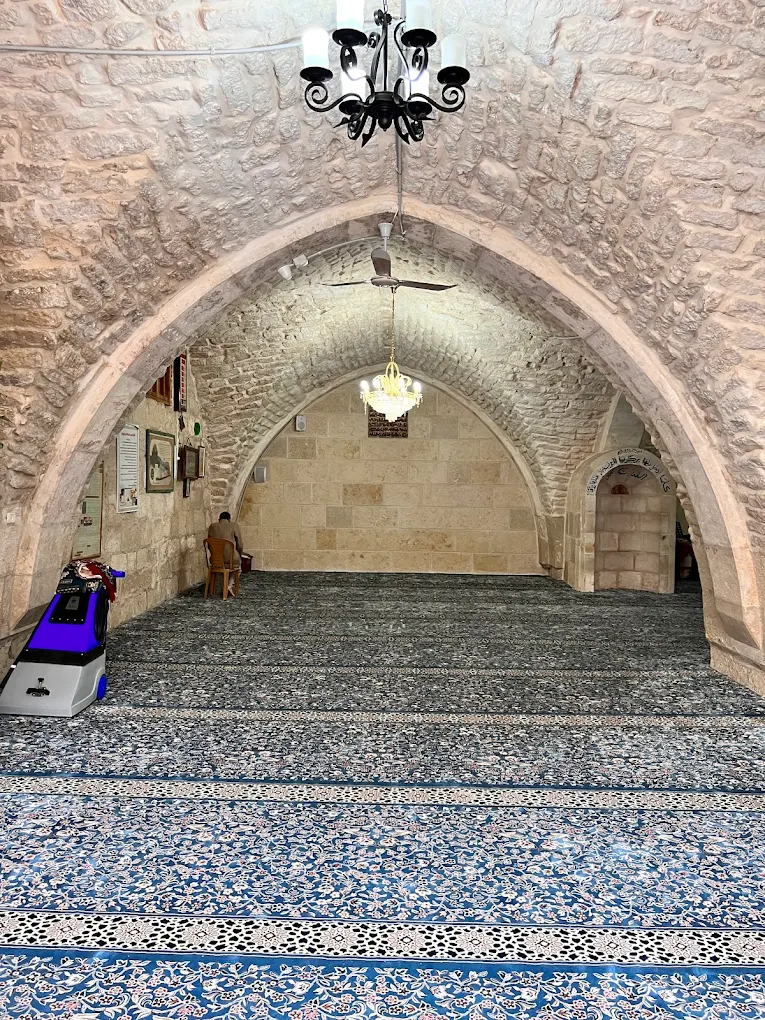
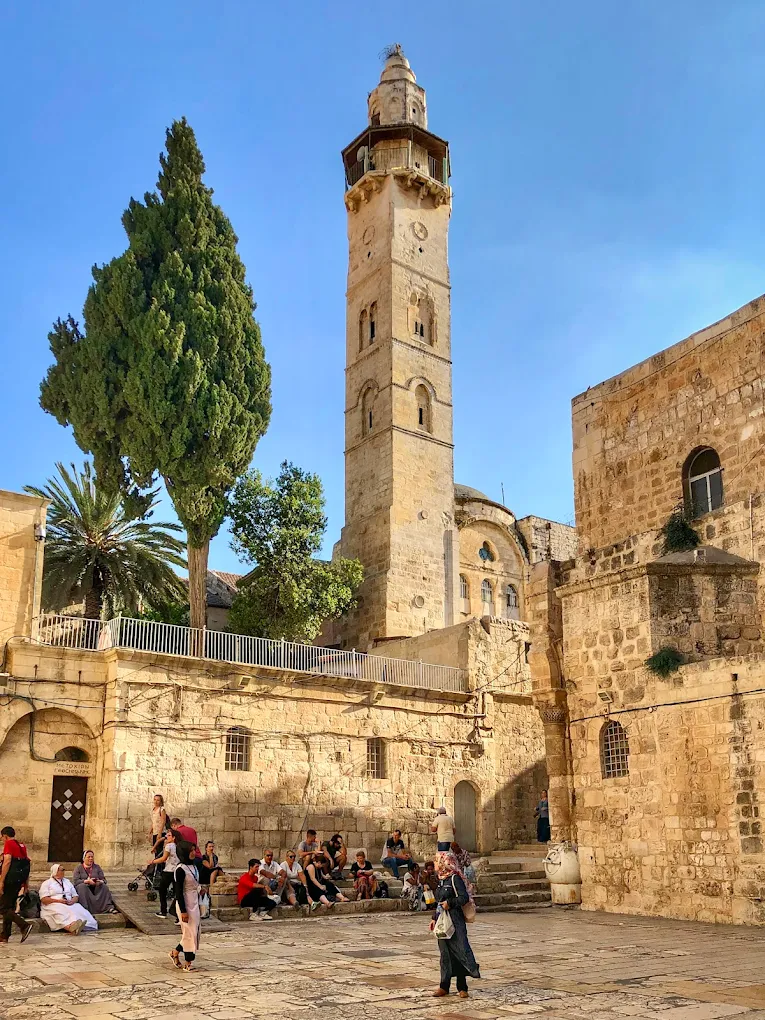
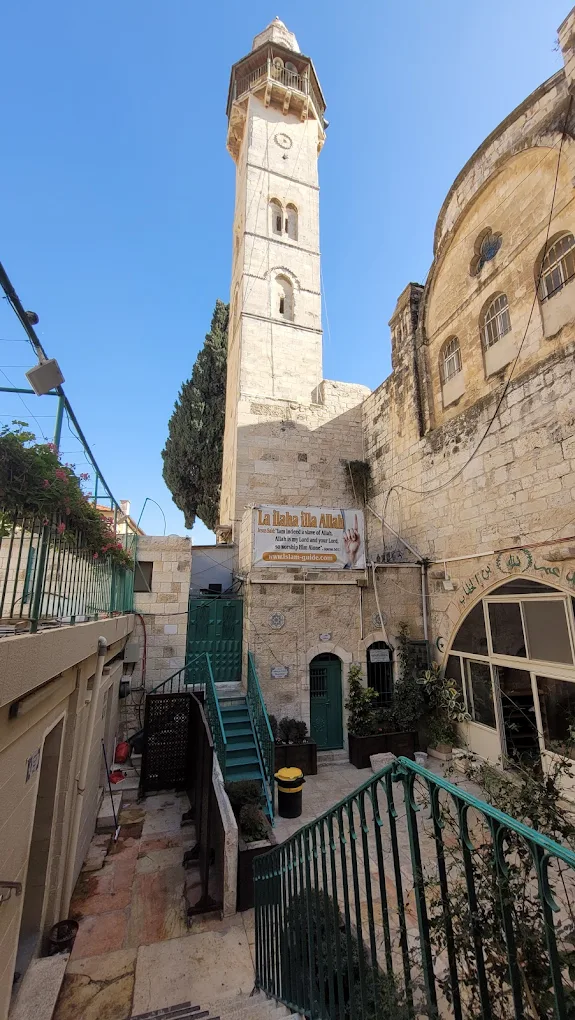
The terms he issued, remembered as the Treaty of Umar, were written down: safety for the people of the city, for their property, their churches and their crosses, with no forced conversion and no seizure of places of worship. The Holy Sepulchre was covered by that guarantee. When the time for salah came during his visit, Sayyiduna Umar (RA) prayed outside the church rather than within it, so that no Muslim after him could treat his prayer as grounds for taking the building. Masjid Omar Ibn al-Khattab stands opposite the courtyard today, marking the spot.
Two parts of the story are often merged in the retelling, and they are worth keeping apart. The covenant of 638 CE established the principle that this church would be protected.
The named families entrusted with the key and the door belong to a later chapter, under Salahuddin in 583 AH / 1187 CE. The promise came first, and the key became the means of keeping it.
The Crusaders took Jerusalem in 1099 CE and the church passed into Latin hands. When Sultan Salahuddin al-Ayyubi retook the city in 583 AH / 1187 CE, he neither closed it nor converted it. He restored Christian worship there and settled the question of access.
The Nusaybah family, already long associated with the door, were confirmed in that role, and the Joudeh al-Ghudayya family were brought into the arrangement as guardians of the key itself. Five years later, the treaty between Salahuddin and Richard the Lionheart secured Christian pilgrims the right to visit the Sepulchre.
The custodianship has stayed in those two households ever since. As with any inheritance measured in centuries, the paper trail is thinner in the Mamluk period than in the Ottoman and modern one, and the honest description is an exceptionally stable custom rather than an unbroken file of deeds.
Both families are custodians of the church door, and both take part in opening it in the morning and closing it at night. The key travels from the Joudeh household to the church, where the two families meet at the entrance. A ladder is passed out through a small hatch in the door to reach the upper lock, the key is turned, and the church opens for the day. In the evening the same is done in reverse, and the key returns to the house it came from.
It is one ceremony carried out together rather than two separate jobs, and it has barely changed in living memory. Both families describe it as an amanah rather than a duty of office. Priests of six denominations wait each morning for their Muslim neighbours to arrive before their holiest building can be entered, and have done so for longer than most modern countries have existed.
The Nusaybah family trace their line to the Ansar of Madinah, through Sayyiduna Ubada ibn al-Samit (RA), a Companion of the Prophet ﷺ. The name is also widely associated with Nusaybah bint Ka'b, Umm Umarah (RA), who defended the Prophet ﷺ at Uhud, though the family's own account treats that connection as honorific rather than a direct genealogy.
Muslim holds key to sacred Christian site
The church is shared between the Greek Orthodox, the Roman Catholic Franciscans and the Armenian Apostolic communities, with smaller portions held by the Coptic, Syriac and Ethiopian Orthodox. Every column, lamp, step and hour of prayer inside is allocated between them.
Those arrangements are precise because the building is shared among communities with distinct traditions and jurisdictions. Questions that seem small elsewhere—who cleans a step, where a chair may stand—carry weight here because they touch on agreements that have governed the church for centuries.
Custodians who belong to none of the six, and who gain nothing whichever way a matter is settled, can open the door fairly for all of them.
The rules governing the church are known as the Status Quo. An Ottoman decree of around 1757, reaffirmed by the firman of Sultan Abdulmecid I in 1852, fixed the balance of rights between the Christian communities, and nothing in the shared areas may be altered without the agreement of all of them.
The best-known consequence sits on a ledge above the entrance: a wooden ladder that has stood there since at least the 1720s, first recorded in an engraving of 1728, because moving it would require a consensus that has never been reached. It has been shifted only twice, and only briefly.
These firmans regulate the Christian denominations among themselves. They did not create the Muslim custodianship, which was already centuries old by then.
The custodianship has survived every change of rule over the city. Ottoman government ended in 1917, the British Mandate came and went, Jordanian administration followed, and after 1967 the Old City came under Israeli control. Through all of it the key stayed in the same house, and the same two families kept arriving each morning.
When the Aedicule over the tomb was finally restored between 2016 and 2017, after seven decades held together by Mandate-era iron girders, the work was funded in part by King Abdullah II of Jordan alongside the World Monuments Fund. On 25 March 2020 the church closed because of the pandemic, and the Joudeh family noted that the last closure of that kind had been in 1349, during the Black Death. It reopened on 24 May 2020.