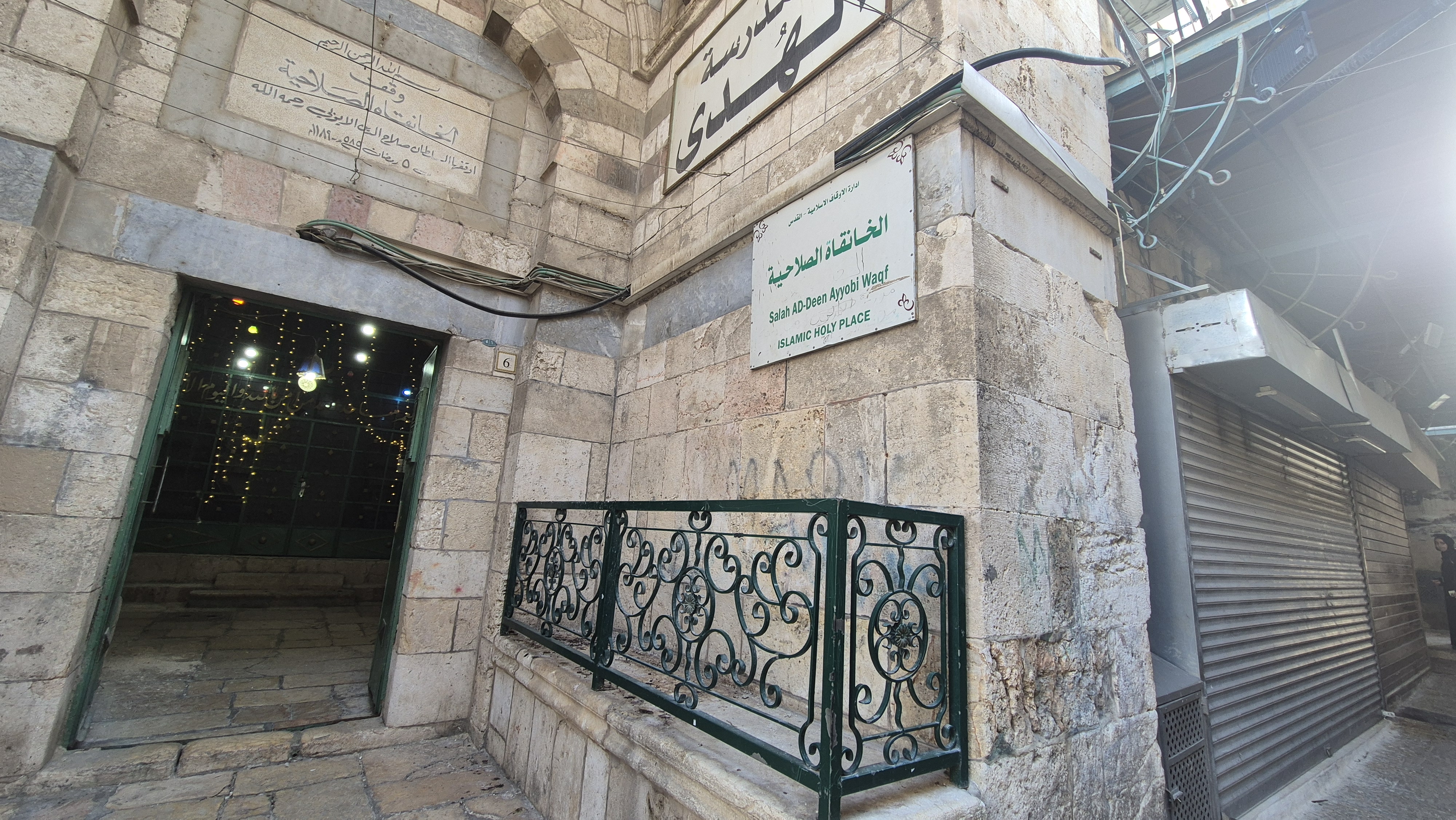
When Salahuddin al-Ayubi took Jerusalem in 583 AH, he chose one building in the Christian Quarter for himself: the palace of the Latin Patriarch, on high…
When Salahuddin al-Ayubi took Jerusalem in 583 AH, he chose one building in the Christian Quarter for himself: the palace of the Latin Patriarch, on high ground overlooking the Church of the Holy Sepulchre. He stayed here, endowed it as a waqf, and turned it into a zawiya — a lodge for worship, teaching and retreat. It has carried his name ever since: al-Khanqah as-Salahiyya, الخانقاه الصلاحية. The house he took, and why he took it The Latin Patriarch was the senior churchman of Crusader Jerusalem, and his palace was the administrative seat of Christian religious authority in the city. It stood a short distance north of the Church of the Holy Sepulchre and looked out over it — the church built on the site where Christians believe Jesus, Nabi Isa (AS) in Islam, was buried and rose. Salahuddin al-Ayubi left the church itself untouched. He honoured the covenant granted by Sayyiduna Umar ibn al-Khattab (RA) in 15 AH, when Jerusalem first came under Muslim rule and its churches were guaranteed in writing to the Christian community — a guarantee that had held for more than five centuries until the Crusader conquest. What he took instead was the seat of authority beside it. Converting the Patriarch's palace into a place of worship and learning, rather than a garrison or a residence for himself, settled the question of who now governed the city without threatening anyone in it. The position also gave a clear view over the quarter, which mattered for keeping order in the weeks after the surrender. The conquest of Jerusalem The Crusader field army was destroyed at the Battle of Hattin in Rabi' al-Thani 583 AH, leaving the city with almost no one to defend it. Jerusalem surrendered by negotiation rather than assault, and Salahuddin al-Ayubi entered on 27 Rajab 583 AH. That is the anniversary of al-Isra wa'l-Mi'raj, the Night Journey, when the Prophet Muhammad ﷺ was taken from Makkah to Masjid al-Aqsa in Jerusalem, led the earlier Prophets in prayer there, and ascended from that place. It is the event that makes Jerusalem the third holiest city in Islam, and the reason Muslims first prayed facing Jerusalem before the direction of prayer turned towards the Ka'bah in Makkah. The conduct of the conquest is why his name still carries the weight it does. When the Crusaders took Jerusalem in 492 AH, they killed its Muslim and Jewish inhabitants in enormous numbers. Salahuddin al-Ayubi set a ransom for the Christian population, then released thousands who could not pay — the old, the widowed, the orphaned — while his brother al-Adil freed a thousand more. Those who left did so under safe conduct with their possessions. Christian chroniclers of the period recorded the terms with evident surprise. He then turned to Masjid al-Aqsa, which the Crusaders had used as a royal residence, with its underground vaults as stables, for eighty-eight years. The building was cleaned and washed with rosewater, the cross was taken down from the Dome of the Rock, and the minbar that Nur al-Din al-Zangi had commissioned in Aleppo years earlier, in anticipation of a day he did not live to see, was brought south and installed. The khalwa beneath the prayer hall On the lower level, below the prayer hall, is a small, plain, low-ceilinged room: the khalwa, a chamber for seclusion. A khalwa is a place of withdrawal from company, used for prayer, recitation and solitude — the same principle as i'tikaf, the practice of retreating into a mosque for a set period, particularly during the last ten nights of Ramadan. A marble plaque set into the wall records that Salahuddin al-Ayubi stayed in this building during Ramadan of 585 AH and prayed here. Tradition holds that he kept i'tikaf in this room, and that those closest to him withdrew here with him. The association is old and has been maintained without interruption by the custodians of the waqf. Two years after taking Jerusalem, at the height of his authority over Egypt and Syria, he returned to a bare room beneath a mosque in the Christian Quarter. The two minarets that face each other The minaret was raised in 1417 under the Mamluk sultans, more than two centuries after the foundation. It is nearly identical to the minaret of the Mosque of Umar on the southern side of the Holy Sepulchre, and the pairing is deliberate: the two stand opposite one another across the church, north and south. The Mosque of Umar marks the place where Sayyiduna Umar (RA) prayed when the city surrendered to him in 15 AH. He prayed outside the church rather than inside it, so that no later generation could use his prayer as grounds to convert the building. Centuries apart, the two minarets mark the same principle from either side. From the courtyard a staircase climbs to the roof. The grey dome of the Holy Sepulchre sits immediately below, with the golden Dome of the Rock beyond it. What he left behind Salahuddin al-Ayubi died in Damascus in Safar 589 AH, four years after his stay in this house. Baha al-Din ibn Shaddad, the judge who served in his household and wrote his biography, records that his estate came to forty-seven dirhams and one piece of gold — not enough to pay for his own burial, which had to be covered by a loan. Everything else had gone into the campaigns and into endowments like this one. The waqf he settled here has outlived him by more than eight centuries. The building still stands, still endowed, and still in use.