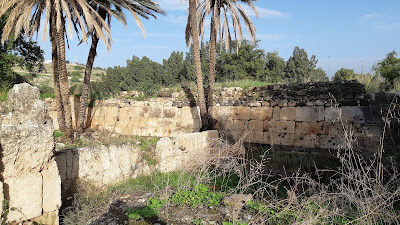
Khirbat al-Minya (خربة المنية), also known as Qasr al-Minya, preserves an Umayyad palatial residence and one of the earliest surviving mosques in Palestine.…
Khirbat al-Minya (خربة المنية), also known as Qasr al-Minya, preserves an Umayyad palatial residence and one of the earliest surviving mosques in Palestine. The complex lies on the northwestern shore of Lake Tiberias, around 14 kilometres north of Tiberias. During the early Islamic period, Tiberias was the capital of Jund al-Urdunn, the District of Jordan within Bilad al-Sham, and an administrative centre on the routes linking Palestine, Damascus and the Jordan Valley. An Umayyad residence beside Lake Tiberias A fragmentary Arabic foundation inscription names al-Walid, placing the palace under one of the two Umayyad caliphs of that name: al-Walid ibn Abd al-Malik, who ruled from 86–96 AH (705–715), or al-Walid ibn Yazid, who ruled in 125–126 AH (743–744). The residence belonged to the wider Umayyad landscape around Tiberias, where caliphs and provincial governors maintained estates close to the district capital. The walled complex was arranged around a colonnaded courtyard, with towers along its outer enclosure and a projecting entrance on the eastern side. Its principal wing contained a large reception hall and a mosque with a mihrab indicating the direction of prayer. Mosaic floors, carved architectural decoration and an associated bath formed part of the palatial establishment. The mosque and the earthquake of 749 The mosque occupied part of the southeastern wing and was integrated into the residence rather than built as a separate congregational mosque. Its position within the palace records the place of worship in Umayyad court and administrative life during Islam’s first century in Palestine. The earthquake of 131 AH (749) severely damaged Khirbat al-Minya while parts of the complex were still unfinished. Archaeologists found a rupture passing through the eastern wing and the mosque’s mihrab, together with collapsed material and unused supplies intended for mosaic work. Later work within the palace Excavations began under German archaeologists in 1932 and continued between 1936 and 1939, followed by further work in 1959 and renewed investigations from 2016. These campaigns established that activity continued after the palace lost its original function. Craftsmen and traders later occupied parts of the enclosure, and installations for processing sugar cane were built among the earlier rooms. Finds include an inscribed Islamic glass weight and material from later medieval settlement, showing how an Umayyad residence became a working site tied to the economy of the Lake Tiberias shore.