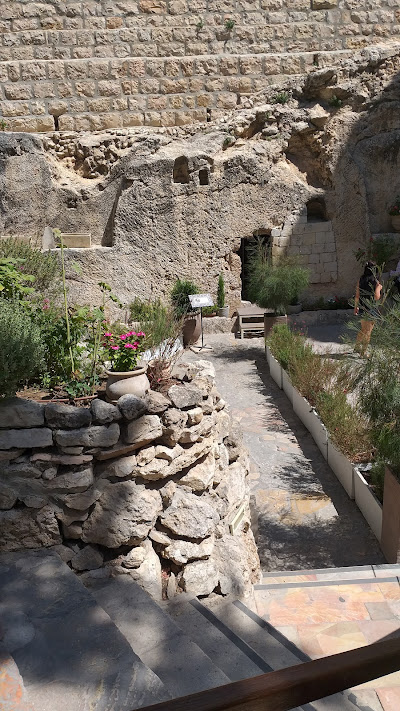
The cave of Qubur al-Anbiya holds the graves of Nabi Haggai (AS), Nabi Zechariah (AS) and Nabi Malachi (AS) on Jerusalem’s Mount of Olives. Known in Arabic as…
The cave of Qubur al-Anbiya holds the graves of Nabi Haggai (AS), Nabi Zechariah (AS) and Nabi Malachi (AS) on Jerusalem’s Mount of Olives. Known in Arabic as قبور الأنبياء, the site lies on the upper western slope of Jabal al-Tur, east of the Old City and Masjid al-Aqsa. Tradition places the three Prophets among those sent to Bani Isra’il during the centuries before Nabi Isa ibn Maryam (AS). The graves beneath Jabal al-Tur The graves occupy a rock-cut underground complex entered from the western side of the mountain. A central circular chamber opens into curved passages and further galleries containing dozens of burial niches. Archaeological study places the earliest parts of the surviving complex in the late Second Temple period. Greek inscriptions show that parts of the cave were used again during the fourth and fifth centuries CE. The site’s identification with Nabi Haggai (AS), Nabi Zechariah (AS) and Nabi Malachi (AS) was recorded in medieval Jewish tradition and later maintained in Christian tradition. The nineteenth-century record The underground chambers were examined during the 1870s by the French archaeologist Charles Clermont-Ganneau. Archimandrite Antonin Kapustin acquired the site in 1882, and an Ottoman court confirmed the transaction in 1890 while preserving access for different religious communities. The cave remains part of the dense sacred landscape of Jabal al-Tur, overlooking the valley that separates the mountain from al-Quds.