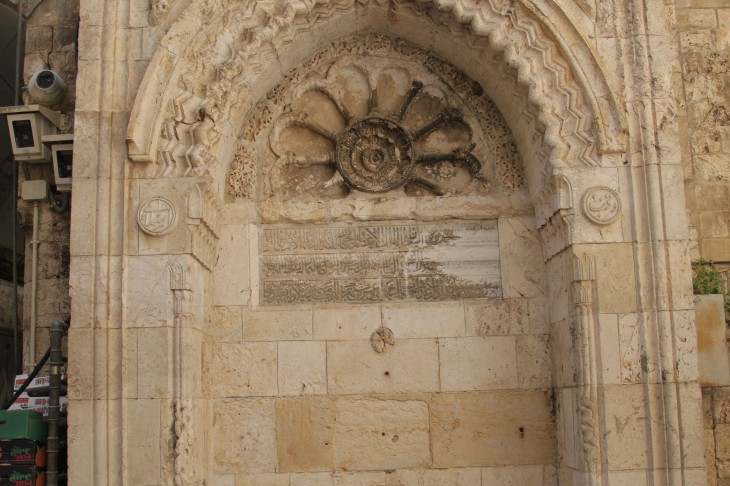
This Ottoman public fountain was completed in 943 AH/1537 beside Bab al-Silsila, one of the western gates of Masjid al-Aqsa. Known in Arabic as سبيل باب…
This Ottoman public fountain was completed in 943 AH/1537 beside Bab al-Silsila, one of the western gates of Masjid al-Aqsa. Known in Arabic as سبيل باب السلسلة, the sabil stands on the western side of the square before Bab al-Silsila and Bab al-Sakina. It adjoins the eastern wall of Turbat al-Sa‘diyya and lies about seven metres from the gates, at the end of Tariq Bab al-Silsila, the historic street leading eastward through Jerusalem’s Old City. Sultan Sulayman’s waterworks Sultan Sulayman al-Qanuni commissioned the fountain as part of his programme to renew Jerusalem’s water supply and establish public sabils along the city’s principal streets. A sabil provided drinking water as a charitable public service, commonly maintained through a waqf, an endowed institution established for continuing benefit. The foundation inscription dates its completion to 22 Rajab 943 AH, corresponding to 4 January 1537. Shari‘a court records preserve a waqf for the fountain from 948 AH/1541–42, followed by later endowments in 1000 AH/1591–92 and 1018 AH/1609–10. Water reached it through Qanat al-Sabil, the aqueduct carrying water from the pools south of Bethlehem towards Jerusalem and Masjid al-Aqsa. The fountain beside the Chain Gate The sabil consists of a recessed niche framed by a pointed chevron arch, with a water trough at its base. Its marble inscription occupies the centre of the niche and names Sultan Sulayman al-Qanuni, son of Sultan Selim, as its patron. Above the inscription is a carved rosette reused from an earlier rose window, an example of older stonework incorporated into Ottoman Jerusalem. The fountain’s position immediately before Bab al-Silsila placed the sultan’s water endowment at a principal approach to Masjid al-Aqsa.