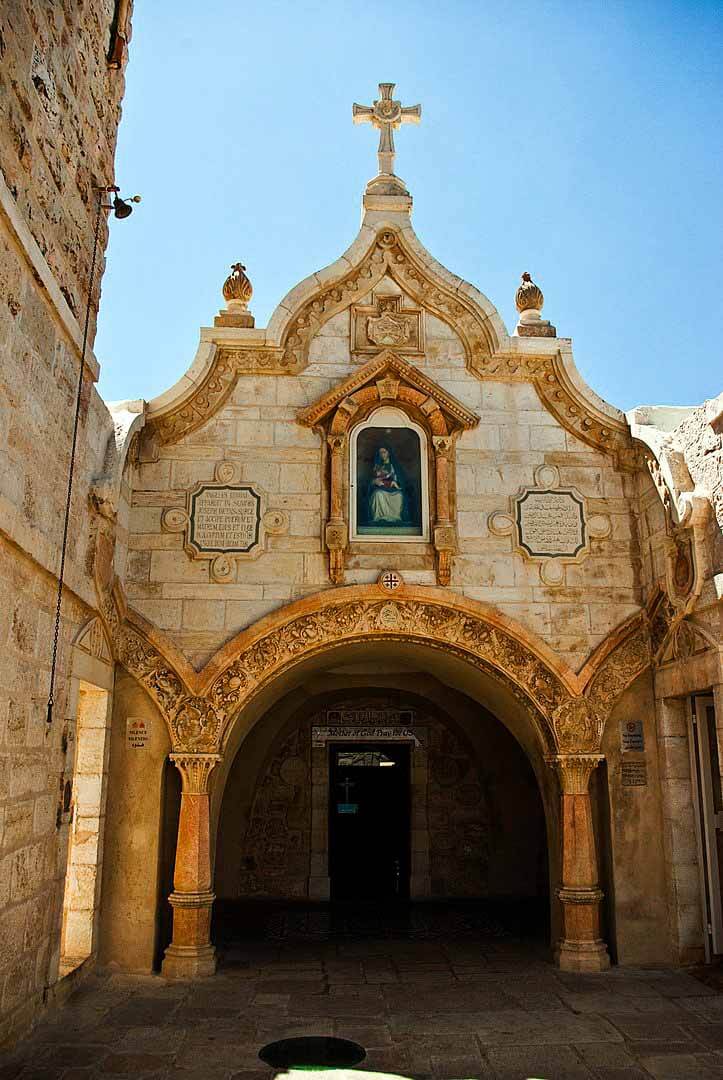
This white-rock cave in Bethlehem is traditionally remembered as the place where Sayyidah Maryam nursed the infant Nabi Isa (AS). Known in Arabic as مغارة…
This white-rock cave in Bethlehem is traditionally remembered as the place where Sayyidah Maryam nursed the infant Nabi Isa (AS). Known in Arabic as مغارة الحليب, Magharat al-Halib or the Milk Cave, it lies southeast of the Church of the Nativity. Christian tradition relates that Sayyidah Maryam rested here with her newborn son before the journey to Egypt, and that a drop of her milk turned the cave’s stone white. The story explains both the cave’s name and its long association with motherhood; it is a transmitted tradition rather than an episode recorded in the Qur’an. Maryam and Isa in the Qur’anic account The Qur’an presents Sayyidah Maryam as a woman chosen and purified by Allah, and Nabi Isa ibn Maryam (AS) as a miraculous sign and mercy. Surah Maryam describes her withdrawing from her people, enduring labour beside a palm tree, and being comforted with water and ripe dates: “Then the pains of labour drove her to the trunk of a palm tree… So a voice reassured her from below her, ‘Do not grieve! Your Lord has provided a stream at your feet. And shake the trunk of this palm tree towards you, it will drop fresh, ripe dates upon you.’” (Qur’an 19:23–25, quran.com/maryam/22-26) This account gives the human setting of Nabi Isa’s (AS) birth: Maryam’s isolation, pain and dependence upon Allah, followed by provision and reassurance. The Milk Cave’s particular association is with the quieter act that followed birth—Maryam feeding and protecting her infant son. That maternal moment has shaped the identity of the cave for many centuries. Bethlehem on the Night Journey Bethlehem also appears in a narration of al-Isra wa’l-Mi‘raj, the Night Journey and Ascension of the Prophet Muhammad ﷺ. Sunan an-Nasa’i relates that Sayyiduna Jibril (AS) instructed him to dismount and pray at places connected with earlier prophets. The narration links Bethlehem, the birthplace of Nabi Isa (AS), directly with the journey onward to Bayt al-Maqdis and Masjid al-Aqsa. It establishes the significance of Bethlehem within the seerah, although it does not identify this particular cave as the place where the Prophet ﷺ prayed. “Do you know where you have prayed? You have prayed in Bethlehem, where Isa, peace be upon him, was born. Then I entered Bayt al-Maqdis (Jerusalem) where the Prophets, peace be upon them, were assembled for me, and Jibril brought me forward to lead them in prayer.” (Sunan an-Nasa’i 450, sunnah.com/nasai:450) The cave beneath the present chapel The Custody of the Holy Land describes the site as having been known since the fourth century. Bethlehem Municipality records an earlier Byzantine church dating to around the fifth century, followed by later rebuilding in the Crusader and Mamluk periods. The present chapel was constructed in 1872 and remains under Franciscan care. Its defining physical feature is the soft, chalk-like white stone of the irregular underground cave. From at least the sixth century, powdered pieces of this rock circulated through Europe and the eastern Mediterranean in traditions connected with nursing and fertility. These reported properties belong to the site’s devotional history and should be understood as such, rather than as established medical claims. The cave’s memory has crossed communal boundaries. The Franciscan custodians record that Muslim women also visit, honouring Sayyidah Maryam and remembering her motherhood. That shared attention has allowed a small cave near Bethlehem’s better-known birthplace sanctuary to preserve something distinct: the image of Maryam not only as the mother who miraculously bore Nabi Isa (AS), but as a woman who sheltered, fed and cared for him.