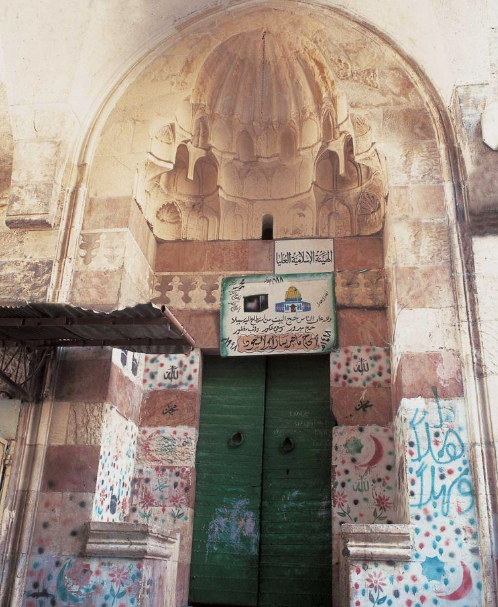
The Madrasa al-Tashtamuriyya (المدرسة الطشتمرية) was founded in 784 AH/1382–83 by the Mamluk amir Sayf al-Din Tashtamur al-Ala’i, who was later buried within…
The Madrasa al-Tashtamuriyya (المدرسة الطشتمرية) was founded in 784 AH/1382–83 by the Mamluk amir Sayf al-Din Tashtamur al-Ala’i, who was later buried within the complex. The foundation combined a madrasa for religious learning with a kuttab for the education of orphans, a sabil supplying water, residential rooms and an attached grave chamber. It stands on the southern side of Tariq Bab al-Silsila, the street leading eastwards to Bab al-Silsila and Masjid al-Aqsa. The amir who withdrew to al-Quds Tashtamur al-Ala’i held several senior offices within the Mamluk state. He became a dawadar, the official responsible for the ruler’s correspondence and inkwell, during the reign of Sultan al-Ashraf Sha‘ban II. His later appointments included the governorship of Damascus and the office of atabak, commander of the army in Egypt. After a period of imprisonment during the rise of Sultan al-Zahir Barquq, Tashtamur was appointed governor of Safad. He instead settled in al-Quds, where the madrasa bearing his name was founded. The inscription on its northern façade records that Tashtamur ordered the construction of “this blessed place” in 784 AH. Tashtamur died in Sha‘ban 786 AH/September–October 1384 and was buried in the grave chamber beside the madrasa. His son Ibrahim was also buried here after his death in 795 AH/1392. A madrasa beside the road to al-Aqsa The complex was arranged around a central court with four iwans, vaulted halls opening from its sides. Historical descriptions record rooms for students and others attached to the institution, together with a kitchen, bath and meeting hall. Religious and linguistic sciences were taught here, while the kuttab provided Qur’an instruction and elementary education for children. The street façade preserves the dated foundation inscription above the entrance. Its Mamluk stonework includes alternating courses of light and dark masonry, carved muqarnas and arched openings. Grilled windows beside the entrance open into the grave chamber, placing the grave of the founder directly along the public frontage of Tariq Bab al-Silsila. The madrasa’s educational functions later ceased. Parts of the former kuttab became shops, upper rooms were adapted as homes, and part of the ground floor came into institutional use, while the grave chamber of Tashtamur al-Ala’i remained within the complex.