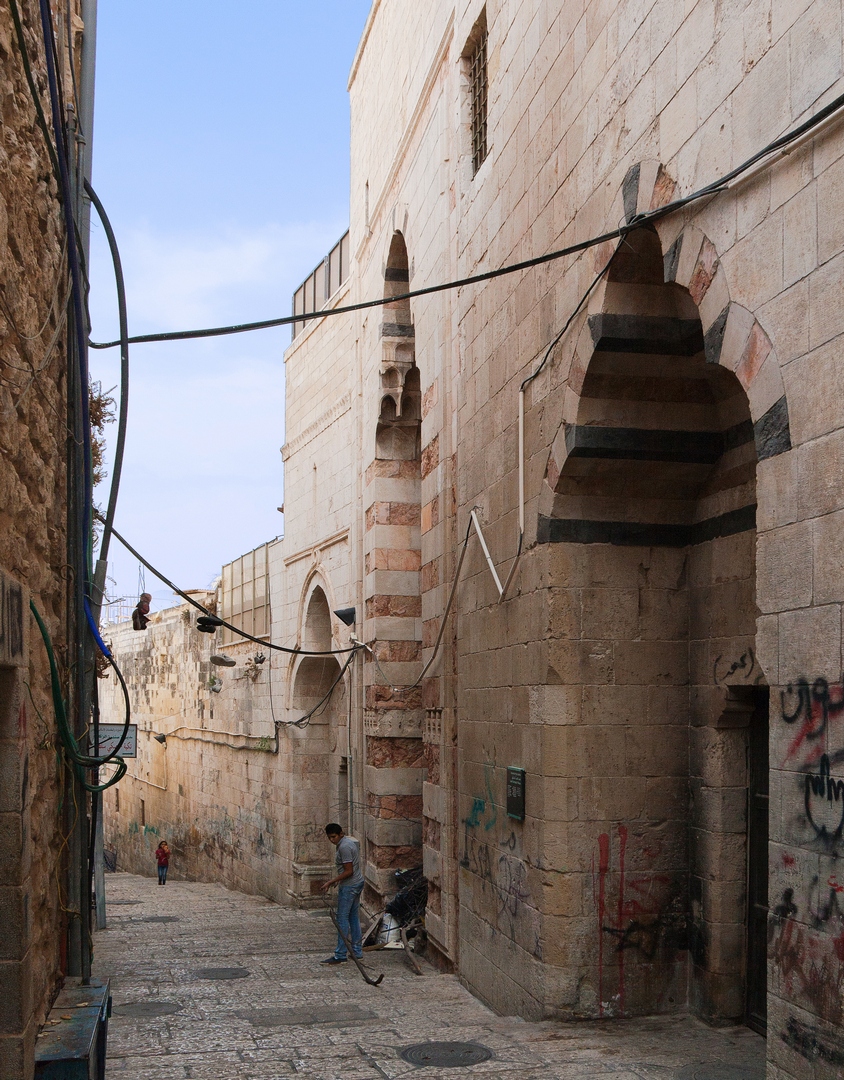
Two major charitable foundations created by Muslim women meet here: Sayyidah Khassaki Hürrem Sultan’s Ottoman kitchen complex and the Mamluk palace and grave…
Two major charitable foundations created by Muslim women meet here: Sayyidah Khassaki Hürrem Sultan’s Ottoman kitchen complex and the Mamluk palace and grave of Sayyidah Tunshuq al-Muzaffariyya. Known in Arabic as تكية خاصكي سلطان وقصر وتربة الست طنشق, the buildings form part of Dar al-Aytam al-Islamiyya in Jerusalem’s Old City. The site lies on Aqabat al-Takiyya, west of Bab al-Nazir, one of the gates of al-Haram al-Sharif. In Jerusalem usage, takiyya came to mean a kitchen distributing food without charge, reflecting the function that remained most closely associated with the complex. The Flourishing Edifice of Sayyidah Khassaki Sultan Sayyidah Khassaki Hürrem Sultan, wife of the Ottoman Sultan Sulayman al-Qanuni, founded the complex in 959 AH/1552. Its endowment deed names it al-Imara al-Amira, “the Flourishing Edifice.” Construction continued for about four years, while the final Arabic waqf deed—establishing property whose income permanently supported charitable work—was registered in 964 AH/1557. The foundation combined a public kitchen with a mosque, a khan for travellers and a ribat containing fifty-five residential cells. It also had a bakery, mill, storerooms and service spaces required to prepare and distribute food on a large scale. Its staff and their duties were set out in the waqf records, from cooks and kitchen assistants to workers responsible for provisions, vessels and maintenance. Revenue came from an extensive group of endowed villages and other properties in Palestine and neighbouring Ottoman districts. Sultan Sulayman al-Qanuni enlarged the endowment in 967 AH/1560, after Sayyidah Khassaki Hürrem Sultan’s death, securing further income for the institution. The kitchen continues to operate under the Islamic waqf administration, while much of the wider group of buildings is occupied by Dar al-Aytam al-Islamiyya and its schools and workshops. The palace and grave of Sayyidah Tunshuq Sayyidah Tunshuq al-Muzaffariyya lived in Jerusalem during the late Mamluk period and commissioned the large residence known as Dar al-Sitt Tunshuq. The Jerusalem historian Mujir al-Din al-Ulaymi records her among the city’s prominent benefactors and notes her support for Shaykh Ibrahim al-Qalandari and his zawiya, a lodge for worship, teaching and retreat, in the Mamilla graveyard. Her palace was completed during the closing years of the fourteenth century. Its surviving frontage on Aqabat al-Takiyya has three monumental portals, while the interior was organised across two principal floors with halls, chambers and a courtyard. The carved portals, coloured stonework and muqarnas decoration belong to the architectural language of Mamluk Jerusalem. Sayyidah Tunshuq al-Muzaffariyya died in 801 AH/1398 and is buried in the grave chamber opposite her palace. The domed chamber and its adjoining rooms formed a religious endowment associated with her foundation. During the Ottoman period, the palace and the neighbouring institutions became integrated into the larger group now called Dar al-Aytam al-Islamiyya; the palace later also served as the residence of Jerusalem’s Ottoman governor.