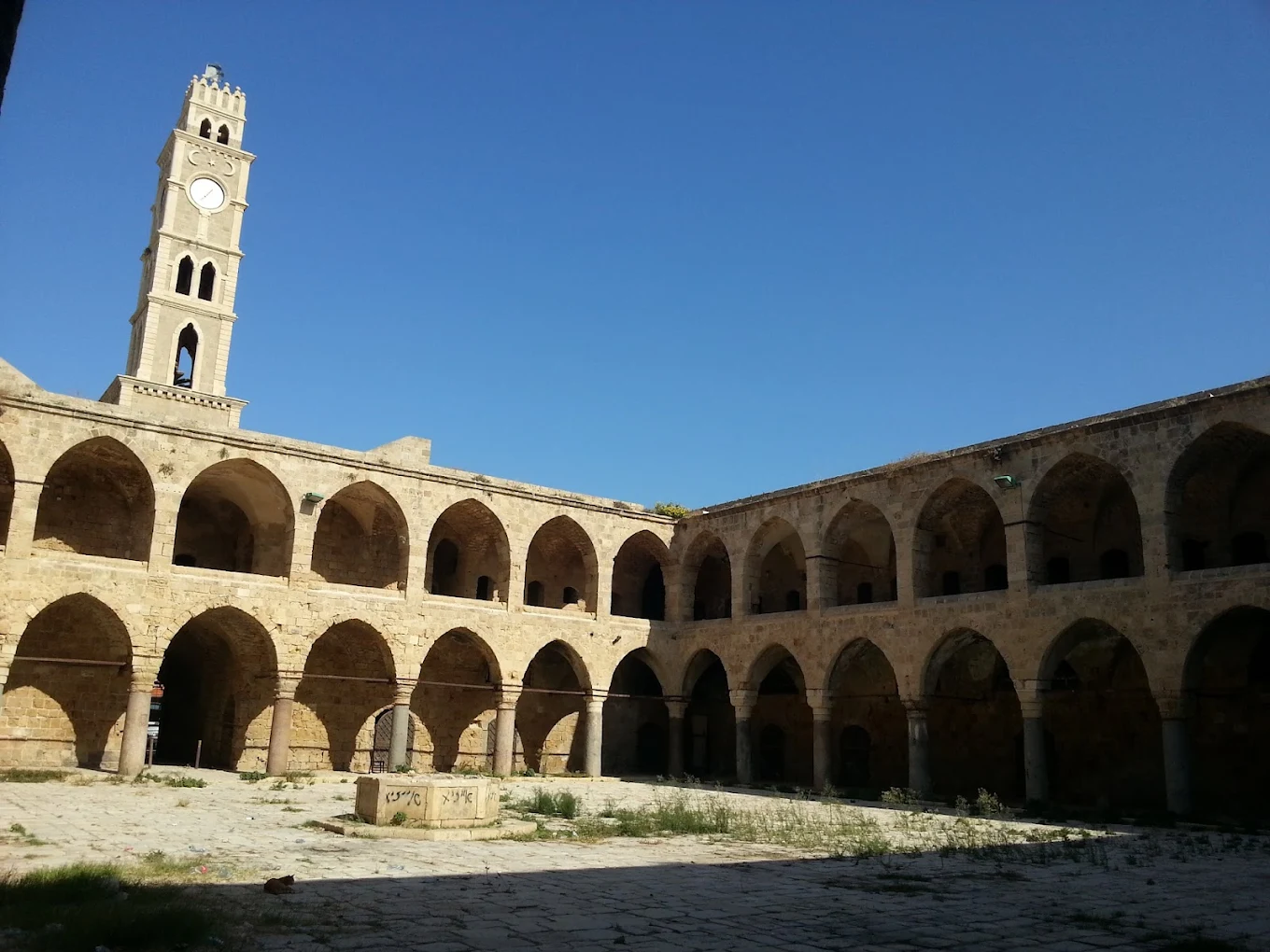
Khan al-Umdan was built beside Acre’s harbour in 1784 by Ahmad Pasha al-Jazzar as a caravanserai for the merchants and goods passing through the Ottoman port.…
Khan al-Umdan was built beside Acre’s harbour in 1784 by Ahmad Pasha al-Jazzar as a caravanserai for the merchants and goods passing through the Ottoman port. Its Arabic name, خان العمدان, means “Khan of the Columns.” A khan combined commercial storage with accommodation for travelling merchants, linking maritime trade to the caravan routes of inland Palestine and the wider lands of al-Sham. Acre’s trade and the rebuilding of the city Acre had become a major centre for the export of cotton under Zahir al-Umar during the eighteenth century. Ahmad Pasha al-Jazzar, who governed from Acre after him, strengthened the city’s fortifications and commissioned mosques, baths, markets and khans that shaped much of the Ottoman city visible today. Khan al-Umdan stood close to the harbour, where merchandise arriving by sea could be unloaded and stored before sale or onward transport. Produce and grain brought from villages across Galilee also passed through Acre’s markets and port, making the khan part of the infrastructure that connected rural production, urban commerce and Mediterranean shipping. The Khan of the Columns The khan was constructed as a two-storey building around a central courtyard. Its lower level provided commercial and storage space, while rooms on the upper level accommodated merchants. Rows of granite columns support the arcades around the courtyard; these columns gave the building its enduring name and are understood to have been brought from Qisarya on the Palestinian coast. The building occupies the site of an earlier customs house from the medieval city. This reuse reflects a wider feature of Acre, where the Ottoman town was raised above and upon earlier structures while retaining much of the inherited urban plan. The clock tower and Waqf al-Jazzar A clock tower was added beside the entrance in 1906 in connection with the silver jubilee of Ottoman Sultan Abdul Hamid II. It belonged to a wider programme of clock towers erected in Palestinian and other Ottoman cities during his reign. Khan al-Umdan forms part of Waqf al-Jazzar, the charitable endowment associated with Ahmad Pasha al-Jazzar’s institutions in Acre. The Old City of Acre, including its Ottoman khans, mosques, baths and fortifications, was inscribed on the UNESCO World Heritage List in 2001.