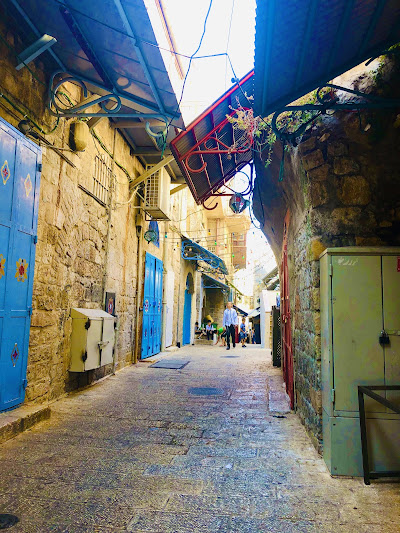
Khan al-Sultan (خان السلطان) was one of Mamluk Jerusalem’s principal commercial inns, where taxable goods were stored and merchants arriving in the city could…
Khan al-Sultan (خان السلطان) was one of Mamluk Jerusalem’s principal commercial inns, where taxable goods were stored and merchants arriving in the city could lodge. Also known as al-Wakala, it was renovated under Sultan al-Zahir Barquq in 788 AH / 1386–87 CE and endowed as a waqf, a charitable endowment, for Masjid al-Aqsa. The khan stands beside Tariq Bab al-Silsila, the historic market road leading east towards Masjid al-Aqsa. Its position joined the city’s central suqs with one of the principal approaches to the sacred precinct, placing commerce directly within the religious and charitable economy of al-Quds. A market endowed for Masjid al-Aqsa An inscription records that the qaysariyya, or market hall, formed a waqf for Masjid al-Aqsa and was renovated by Sultan al-Zahir Barquq. Revenue from the complex therefore supported the upkeep of the sacred precinct rather than serving commerce alone. The Jerusalemite historian Mujir al-Din al-Ulaymi described the complex in the late ninth century AH / fifteenth century CE as a wakala, a place where goods subject to taxation were received and stored. Its annual income was reported at about 400 gold dinars. Goods entering Jerusalem were assessed and distributed from here to traders in the surrounding markets. Merchants, goods and animals under one roof The complex was arranged on two levels around a central courtyard. The lower level accommodated merchandise and animals brought from Jerusalem’s surrounding countryside, while upper rooms provided private lodging for travelling merchants. A covered passage linked the khan to Tariq Bab al-Silsila and opened into a market street lined with shop bays. Architectural investigation identifies the vaulted market passage as an earlier structure that was built or renewed during the Crusader period, while the main khan belongs to the Mamluk development of the site. The Mamluk plan resembles the urban trading complexes of Cairo, Damascus and Aleppo, where storage, taxation, wholesale exchange and accommodation were gathered within a single institution. Later uses of the khan The building continued to serve Jerusalem’s working markets after the Mamluk period. Parts of it were used for shops, storage and workshops, while upper chambers became homes. A 2016 excavation within a ground-floor residential unit recovered material from the Fatimid, Mamluk and Ottoman periods, showing that the site preserves evidence from several stages of the city’s commercial history.