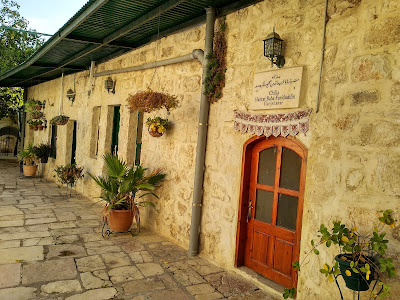
The underground khalwa where Shaykh Farid al-Din Masud Ganj Shakar spent forty days in retreat became the nucleus of Jerusalem’s Indian Hospice. Known in…
The underground khalwa where Shaykh Farid al-Din Masud Ganj Shakar spent forty days in retreat became the nucleus of Jerusalem’s Indian Hospice. Known in Arabic as al-Zawiya al-Hindiyya (الزاوية الهندية), the waqf stands inside the Old City near Bab al-Zahira and preserves an Indian Muslim presence established in the city around eight centuries ago. The complex grew around Baba Farid’s chamber into a zawiya—a lodge for worship, teaching and hospitality—with a mosque and accommodation for travellers from the Indian subcontinent. It later received Indian pilgrims journeying through Jerusalem on their way to or from the Hajj. Baba Farid’s forty days in Jerusalem Baba Farid was born in Punjab in the sixth century AH and studied under Shaykh Qutb al-Din Bakhtiyar Kaki, one of the leading teachers of the Chishti path. He later settled at Ajodhan, now Pakpattan in Pakistan, where he taught until his death in 664 AH / 1265 CE and where he is buried. Tradition holds that Baba Farid reached Jerusalem in the early thirteenth century, after Salahuddin al-Ayubi had recovered the city and established institutions for Muslim scholars and worshippers. Baba Farid entered a forty-day khalwa—an extended period of seclusion for worship—in an underground chamber near Bab al-Zahira. Accounts of his stay also preserve that he swept the streets around the sanctuary as an act of humility. After Baba Farid returned to Punjab, Muslims arriving from India kept his Jerusalem khalwa in memory. The chamber became known as the Zawiya al-Faridiyya, while the growing waqf around it acquired the name Zawiya al-Hindiyya. The Ottoman traveller Evliya Çelebi included the Indian zawiya among the religious lodges of seventeenth-century Jerusalem. From a khalwa to an Indian waqf Indian Muslims acquired neighbouring properties and endowed them for the zawiya’s work. A substantial rebuilding in 1286–87 AH / 1869–70 CE expanded its ability to house pilgrims from India and Central Asia. The resulting institution became both a Jerusalem zawiya and a hospice identified with the Muslim communities of the Indian subcontinent. In the early twentieth century, Jerusalem’s Supreme Muslim Council sought help from the Indian Khilafat Movement in restoring the waqf. Shaykh Nazir Hasan Ansari arrived from Saharanpur in 1924 and took responsibility for the hospice. He travelled in India to secure support for its repair and expansion, then married a Palestinian woman and established the Ansari family’s Jerusalem branch. During the Second World War the hospice accommodated Indian soldiers serving in the region. Its later facilities included guest rooms, a mosque, a library and records preserving correspondence, deeds and photographs connected with the waqf and its Indian patrons. The Ansari family in Jerusalem Shaykh Muhammad Munir Ansari, born in Jerusalem in 1928, succeeded his father in the early 1950s. The hospice was badly damaged during the fighting of 1967, when members of the household were killed and Shaykh Muhammad Munir Ansari was wounded. The family subsequently repaired the compound and maintained its work as an Indian Islamic endowment. Shaykh Muhammad Munir Ansari received India’s Pravasi Bharatiya Samman in 2011 and Palestine’s Star of Jerusalem in 2019. He died on 24 May 2024 at the age of ninety-six. Responsibility for the hospice passed within the Ansari family, with his son Nazeer Ansari serving as its director and trustee.