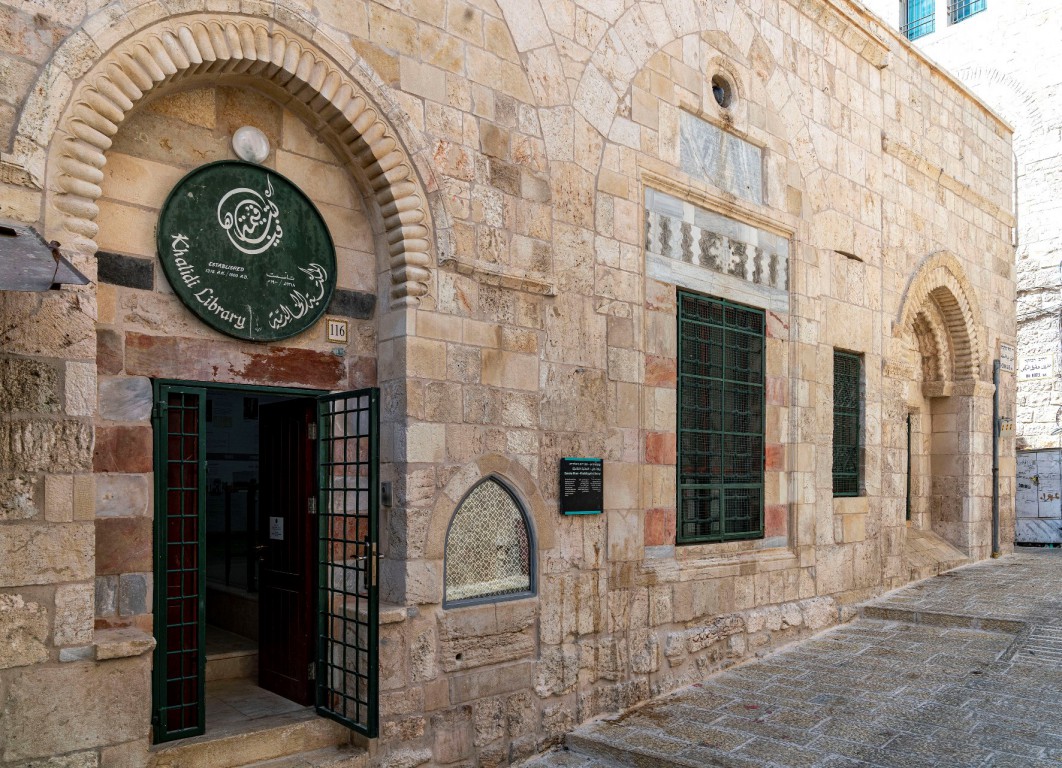
The Khalidi Library preserves Palestine’s largest private collection of Arabic manuscripts beside the graves of Amir Husam al-Din Barka Khan and his sons.…
The Khalidi Library preserves Palestine’s largest private collection of Arabic manuscripts beside the graves of Amir Husam al-Din Barka Khan and his sons. Known in Arabic as al-Maktaba al-Khalidiyya (المكتبة الخالدية), it opened in 1900 as the first Arab public library in Palestine founded through private initiative. The library stands on Tariq Bab al-Silsila in Jerusalem’s Old City, close to Bab al-Silsila, one of the gates of Masjid al-Aqsa. Its home is the medieval funerary complex known as Turbat Barka Khan, later incorporated into the Khalidi family’s properties and waqf, an Islamic endowment established to preserve property and sustain its designated purposes. The graves of Barka Khan and his sons Amir Husam al-Din Barka Khan was a Khwarazmian commander from the Central Asian military generation that entered the lands of Egypt and Sham during the thirteenth-century struggles against the Crusaders. His daughter married the Mamluk Sultan Baybars and became the mother of al-Malik al-Sa‘id Baraka Khan, who succeeded his father as sultan in 676 AH/1277. Amir Husam al-Din Barka Khan is buried here with his sons, Amir Husam al-Din Kara Beg and Amir Badr al-Din Muhammad Beg. An inscription dated 1 Dhu al-Qadah 792 AH/11 October 1390 records building work commissioned by Muhammad ibn Ahmad ibn Timur al-‘Ala’i at the turba, including its window, dome, entrance and associated waqf properties. A Jerusalem family’s library Hajj Raghib al-Khalidi established the library from collections assembled by generations of the Khalidi family, whose members served Jerusalem and the wider Ottoman lands as judges, scholars, muftis, officials and writers. The earliest nucleus of the endowed collection dates to 1133 AH/1720, nearly two centuries before the public library opened. The family’s intellectual life extended from the Islamic sciences to the Arab Nahda, the nineteenth-century revival of Arabic scholarship and literature. Among its prominent figures were Yusuf Diya al-Khalidi, an Ottoman statesman and scholar, and Ruhi al-Khalidi, a writer, diplomat and historian. Their papers form part of the library’s archive. The manuscript collection The Khalidiyya holds 1,263 manuscript volumes: 1,209 in Arabic, 36 in Ottoman Turkish and 18 in Persian. Composite volumes bring the Arabic collection to around 2,000 individual titles, covering Qur’anic interpretation and recitation, hadith, Islamic law, theology, Arabic grammar and rhetoric, medicine, astronomy, mathematics and literature. Its oldest dated manuscript is a collection of hadith by Abu al-Hasan al-Qabisi, copied in 418 AH/1027. Other holdings include teaching certificates, presentation copies, works by scholars of Ottoman Palestine and manuscripts gathered by Khalidi family members during study and judicial service in Jerusalem, Cairo, Istanbul and other centres of Islamic learning. Between 2014 and 2016, the library worked with the Hill Museum and Manuscript Library to digitise its manuscript collection. Around 600,000 pages were photographed, catalogued and made searchable, while a conservation facility was established in Jerusalem for the care and restoration of manuscript collections.