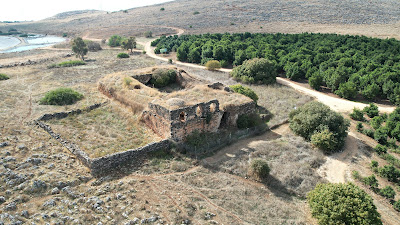
Khan Jubb Nabi Yusuf (خان جُبّ يوسف) was a Mamluk caravanserai beside the well associated with Prophet Yusuf (AS), south of Safed. The khan stands about 80…
Khan Jubb Nabi Yusuf (خان جُبّ يوسف) was a Mamluk caravanserai beside the well associated with Prophet Yusuf (AS), south of Safed. The khan stands about 80 metres west of Jubb Yusuf, linked to it by a partly rock-cut path. It served traffic crossing the Galilee on the routes between Damascus, Safed, Tiberias and Egypt, providing a protected stopping place for merchants, animals and other travellers. The well of Prophet Yusuf The khan took its name from Jubb Yusuf, the well traditionally held to be where the brothers of Prophet Yusuf (AS) cast him before a passing caravan carried him towards Egypt. The Qur’an makes the caravan part of this decisive moment in his story: “One of them said, ‘Do not kill Joseph. But if you must do something, throw him into the bottom of a well so perhaps he may be picked up by some travellers.’” Surah Yusuf 12:10 Prophet Yusuf (AS), the son of Prophet Yaqub (AS), was later sold in Egypt, endured imprisonment after refusing wrongdoing, and was entrusted with authority over the storehouses of the land. His brothers eventually came before him during famine, and Prophet Yusuf (AS) forgave them before his family was reunited. A station on the Damascus road The route was recognised long before the surviving khan took its present form. Al-Muqaddasi recorded Jubb Yusuf in the tenth century as a stopping place on the Damascus road. Salahuddin al-Ayubi also stopped in the area while travelling towards the campaign that culminated in the Battle of Hattin in 583 AH/1187. When Ibn Battuta reached Jubb Yusuf in the fourteenth century, he described the well within the courtyard of a small mosque and drank from its water. Architectural study of the khan’s masonry places its surviving medieval fabric tentatively in the Mamluk period, possibly as early as the fourteenth century. In 1470, the Flemish traveller Anselm Adornes recorded a well-built inn near the well and described it as recent. The caravanserai and its water supply The khan was arranged around a rectangular courtyard, with vaulted accommodation and service spaces for travellers, goods and animals. Its documented features include a northern entrance passage, a prayer chamber with a mihrab and a substantial cistern at the northwestern side. Limestone and basalt were used in its heavy masonry. In the early eighteenth century, the Damascene scholar Abd al-Ghani al-Nabulsi described a well-built khan here, together with the domed well, a nearby mosque and the grave of Shaykh Abdullah. Johann Ludwig Burckhardt found the caravanserai falling into ruin in 1822, and a nineteenth-century survey still recorded it beside the main road to Damascus.