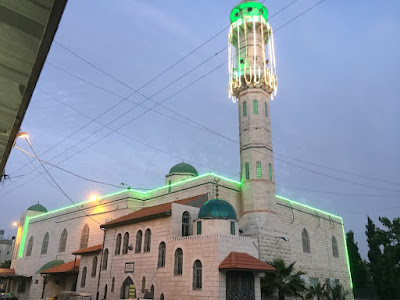
Halhul, five kilometres north of al-Khalil, has been associated with Nabi Yunus (AS) for at least eight hundred years. The grave honoured in his name stands…
Halhul, five kilometres north of al-Khalil, has been associated with Nabi Yunus (AS) for at least eight hundred years. The grave honoured in his name stands on Mount Nabi Yunis, the highest ground in the West Bank, and both the hill and the mosque upon it carry his name. Nabi Yunus Nabi Yunus (AS), son of Matta, was sent to the people of Nineveh in the land of Iraq. He called them away from the idols they had taken and warned them of what was coming, and for a long time they would not answer him. He departed from them before his Lord had given him leave, and boarded a laden ship. When lots were cast he was the one cast out, and the great fish took him. He called upon Allah from within that darkness: "And he called out within the darknesses, 'There is no deity except You; exalted are You. Indeed, I have been of the wrongdoers.' So We responded to him and saved him from the distress. And thus do We save the believers." Surah al-Anbiya 21:87-88 . Allah answered him and delivered him onto the open shore, where a plant was made to grow over him. His people, meanwhile, believed before the punishment reached them, and it was lifted from them — the one town in the Qur'anic accounts whose faith came in time to save it. Nabi Yunus (AS) returned to them, and Allah names him in the Qur'an as Dhun-Nun and as Sahib al-Hut, the companion of the fish, and instructs the Prophet Muhammad ﷺ not to be like him in haste. What the sources record Ali al-Harawi noted the grave of Yunus ibn Matta at Halhul in 1173, when the country was under Crusader rule, and Yaqut al-Hamawi recorded it again in 1226. Victor Guerin, visiting in 1863, described the Jami' an-Nabi Yunis as built of ancient stone. A limestone slab bearing an early Arabic epitaph was recovered at the site during repairs. It was read by the historian Moshe Sharon as dating to the spring of 966, in the Fatimid period, and remains among the older Islamic inscriptions found in Palestine.