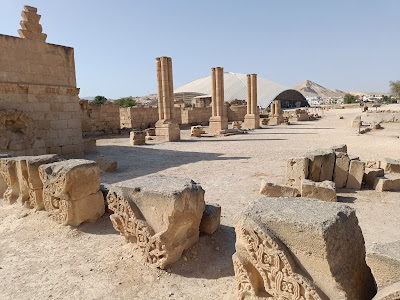
Hisham’s Palace is one of Palestine’s principal Umayyad archaeological sites, built beside the Jericho oasis during the caliphate of Hisham ibn Abd al-Malik.…
Hisham’s Palace is one of Palestine’s principal Umayyad archaeological sites, built beside the Jericho oasis during the caliphate of Hisham ibn Abd al-Malik. Known in Arabic as Qasr Hisham (قصر هشام) and Khirbat al-Mafjar (خربة المفجر), the complex combined royal reception, worship, bathing and agriculture within a single estate. Caliph Hisham ruled from 105 to 125 AH (724–743 CE), when the Umayyad caliphate was governed from Damascus. Written material discovered at Khirbat al-Mafjar links the estate with his reign, while its later decoration is connected with his successor, al-Walid ibn Yazid, who ruled briefly in 125–126 AH (743–744 CE). An Umayyad estate beside Jericho The complex was established on the northern bank of Wadi Nuway‘ima, north of Jericho in the Jordan Valley. Its position joined the cultivated lands and springs of the oasis to routes crossing Palestine and the wider lands of al-Sham. Water channels supplied the residence, bathhouse, pools and agricultural estate. The principal buildings included a palace, a congregational mosque, a smaller mosque within the residential complex, an audience hall and great bath, and a monumental fountain set within a shared forecourt. The northern area formed a day‘a, an agricultural estate that continued in use into the Abbasid period. Excavations there uncovered rooms, a grape press and later structures built among the Umayyad remains. A major earthquake in 131 AH (749 CE) brought down substantial parts of the complex. Archaeological study of pottery and later construction has shown that activity at Khirbat al-Mafjar continued after the Umayyad period, with occupation extending through later Islamic centuries. The mosaics of the great bath The great bath and audience spaces preserve some of the most extensive mosaic floors known from the early Islamic period. Their geometric compositions are accompanied by carved stucco, frescoes and stone sculpture, showing the range of craftsmen employed for an Umayyad courtly estate. The best-known figurative panel lies in the private audience room adjoining the bath. It depicts a fruit-bearing tree with gazelles on one side and a lion attacking a gazelle on the other. The larger bath-hall floor is arranged as a broad carpet of interlocking geometric designs, with dozens of distinct patterns distributed around the bases of its supporting piers. A protective shelter constructed with support from the Japan International Cooperation Agency now covers and presents the great bath mosaics. The completed display was inaugurated in 2021, allowing the floor to remain visible while shielding it from weather and environmental damage. Palestinian archaeology at Khirbat al-Mafjar The first extensive excavations were directed between 1935 and 1948 by the Palestinian archaeologist Dimitri Baramki through the Department of Antiquities, working with Robert Hamilton. Baramki’s campaigns uncovered the palace, mosques, bath complex and much of the decoration that established Khirbat al-Mafjar as a central site for the study of Umayyad art. Fieldwork resumed in 2006 under Hamdan Taha of the Palestinian Department of Antiquities. The later Jericho Mafjar Project, conducted with the University of Chicago, examined the northern settlement and the complex’s relationship with early Islamic Jericho. Hisham’s Palace was placed on Palestine’s UNESCO Tentative List in 2020.