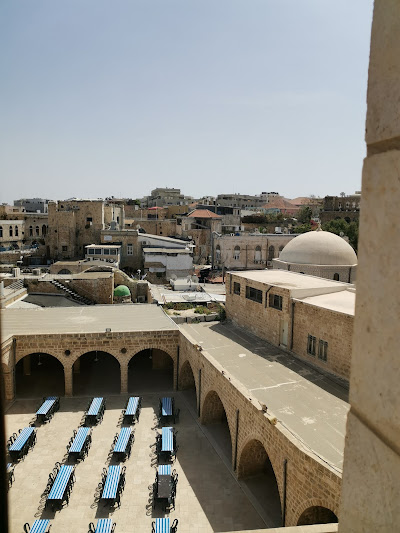
Jaffa’s Great Mahmoudiya Mosque is the city’s principal Ottoman congregational mosque, rebuilt by Muhammad Agha Abu Nabbut in 1812. Known in Arabic as…
Jaffa’s Great Mahmoudiya Mosque is the city’s principal Ottoman congregational mosque, rebuilt by Muhammad Agha Abu Nabbut in 1812. Known in Arabic as al-Jami‘ al-Mahmoudi (الجامع المحمودي), it stands beside Jaffa’s Clock Tower Square near the northeastern edge of the old city. Its courtyards, prayer hall, minaret and public fountain preserve the work of several Ottoman patrons. From the Bibi family mosque to Jaffa’s great mosque Jerusalem Islamic court records identify an earlier mosque established here by Shaykh Muhammad al-Bibi in 1148 AH/1735. He endowed property for its support in 1158 AH/1745, creating a waqf: a permanent charitable endowment whose income maintained a religious institution. Muhammad Agha Abu Nabbut, Ottoman governor of Jaffa and Gaza from 1807, enlarged and substantially rebuilt the mosque between 1810 and 1812. His project formed part of Jaffa’s recovery after the destruction of 1799, alongside work on the city walls, port, markets, khans and public water supply. The mosque was also known as Jami‘ Abu Nabbut after its patron, al-Jami‘ al-Jadid—the New Mosque—to distinguish it from Jaffa’s older congregational mosque, and Jami‘ al-Balad, the Mosque of the City. Abu Nabbut’s waqf and new civic centre Abu Nabbut supported the mosque through a group of waqf deeds drawn up between 1812 and 1816. The endowment included bazaars, khans, houses, land and shops whose revenues funded the mosque, its madrasa and associated water fountains. The main western courtyard, arcades, rectangular prayer hall with two shallow domes and the minaret belong to Abu Nabbut’s rebuilding. The complex later expanded eastward after sections of Jaffa’s walls were dismantled during the nineteenth century, placing the mosque at the centre of a developing civic and commercial quarter. The fountain of Sulayman Pasha A sabil, or public drinking fountain, is set into the mosque’s southern wall. It was established by Sulayman Pasha, governor of Acre and Abu Nabbut’s superior, during the early nineteenth-century rebuilding. Together with another fountain outside Jaffa, it linked Abu Nabbut’s mosque project with the provision of water along the city’s streets and roads. The mosque ceased regular use amid the displacement of Jaffa’s Palestinian population in 1948 and reopened in 1982. A later programme of repair and restoration was carried out between 2010 and 2016, preserving the complex as an active mosque within the old city.