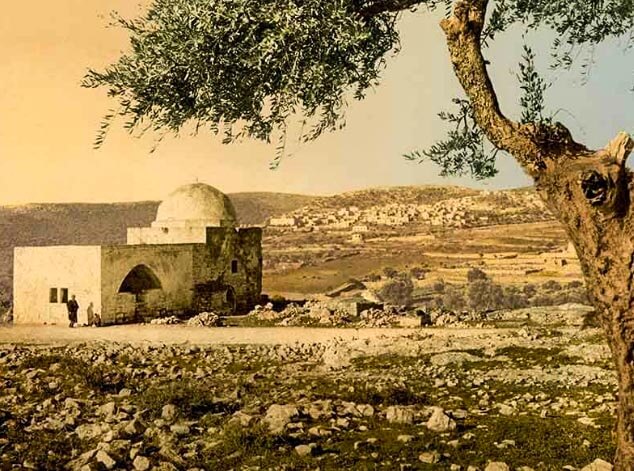
Sayyidah Rahil is buried at this maqam on the historic road between Bethlehem and al-Khalil in Palestine. She was the wife of Nabi Yaqub (AS), the mother of…
Sayyidah Rahil is buried at this maqam on the historic road between Bethlehem and al-Khalil in Palestine. She was the wife of Nabi Yaqub (AS), the mother of Nabi Yusuf (AS) and Binyamin, and a member of the household descended from Nabi Ibrahim (AS). Known in Arabic as Qabr Rahil (قبر راحيل) and Qubbat Rahil (قبة راحيل), the site stands at the northern entrance to Bethlehem. It is also associated with Masjid Bilal ibn Rabah (مسجد بلال بن رباح), the prayer place established beside the grave. Sayyidah Rahil and the family of Nabi Yaqub Sayyidah Rahil is not named directly in the Qur’an, but classical Muslim historians and mufassirun identify her as the mother of Nabi Yusuf (AS) and his full brother Binyamin. The Qur’an recounts how the other sons of Nabi Yaqub (AS) spoke of Nabi Yusuf (AS) and his brother together, before Nabi Yusuf (AS) was cast into the well and carried to Egypt. Muslim historical tradition records that Sayyidah Rahil died when Binyamin was born, while Nabi Yusuf (AS) was still young. During the family’s journey towards al-Khalil, she was buried beside the road near Bethlehem. Her grave therefore belongs to the opening background of the story of Nabi Yusuf (AS), before his separation from Nabi Yaqub (AS) and his later rise in Egypt. The maqam recorded by al-Idrisi The Muslim geographer al-Idrisi described the grave in the mid-12th century. He placed it on the road between Jerusalem and Bethlehem, identified Sayyidah Rahil as the mother of Nabi Yusuf (AS) and Binyamin, and recorded that twelve stones covered the grave beneath a vaulted dome. His account shows that the location and the family connection preserved here were already known to Muslim geographers of medieval Palestine. The complex was rebuilt during the Ottoman period. Palestinian historical records name Muhammad Pasha in connection with construction at the site in 1560, when walls and a dome were raised around the grave. Further additions during the 19th century included rooms, a passage and a mihrab for Muslim prayer. A Muslim graveyard also adjoins the maqam.