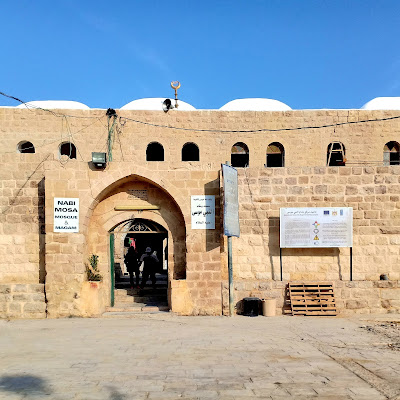
Nabi Musa (AS) is buried at this maqam in al-Bariyah, the desert country between Jerusalem and Jericho. Known in Arabic as Maqam al-Nabi Musa (مقام النبي…
Nabi Musa (AS) is buried at this maqam in al-Bariyah, the desert country between Jerusalem and Jericho. Known in Arabic as Maqam al-Nabi Musa (مقام النبي موسى), the site stands beside the historic road east from Jerusalem, near the red hill described in the hadith. The Prophet Muhammad ﷺ related that Nabi Musa (AS) asked Allah to bring him close to the Sacred Land at the end of his life: “Moses then requested Allah to let him die close to the Sacred Land so much so that he would be at a distance of a stone's throw from it.” Allah’s Messenger ﷺ said, “If I were there, I would show you his grave below the red sand hill on the side of the road.” Sahih al-Bukhari 3407 Nabi Musa and the journey to the Sacred Land Nabi Musa (AS) was sent with his brother Nabi Harun (AS) to Pharaoh, calling him to worship Allah and commanding him to release the oppressed Bani Isra'il. Allah supported Nabi Musa (AS) with clear signs, saved him and his people through the parted sea, and drowned Pharaoh and his forces. Nabi Musa (AS) later received the Tawrah and led Bani Isra'il through the wilderness towards the Sacred Land. His life therefore joins Egypt, Sinai and the lands around Bayt al-Maqdis in one of the Qur’an’s most extensive prophetic narratives. Sahih Muslim also relates that during al-Isra wa'l-Mi'raj, the Prophet Muhammad ﷺ passed Nabi Musa (AS) near the red mound and saw him praying in his grave. The building commissioned by Sultan Baybars The surviving foundation inscription records that the Mamluk Sultan al-Zahir Baybars ordered the maqam to be built over the grave in 668 AH/1269–70. Ibn Shaddad al-Halabi, the sultan’s biographer, likewise records that Baybars built a dome and mosque at the red hill south of Jericho and established a waqf, an endowed property, to support the imam, muezzin and the maqam’s expenses. The complex was enlarged in the later Mamluk period, including major work around 885 AH/1480 and the addition of its minaret. Further restorations followed under Ottoman rule, with inscriptions recording work in the seventeenth, eighteenth and nineteenth centuries. The mosque, grave chamber, halls, courtyards and accommodation formed one of Palestine’s largest endowed religious complexes. The Nabi Musa mawsim The maqam became the destination of the Nabi Musa mawsim, a major Palestinian annual gathering historically linked with Jerusalem and Masjid al-Aqsa. Processions travelled east from Jerusalem through al-Bariyah to the grave near Jericho, while the maqam’s extensive waqf supplied the institution and its large body of staff. Land and water rights around Jericho and Wadi al-Qilt, together with villages elsewhere in Palestine, were assigned to the endowment. These revenues sustained the mosque and the facilities built around the grave, joining the memory of Nabi Musa (AS) to the religious and social history of Jerusalem and Jericho.