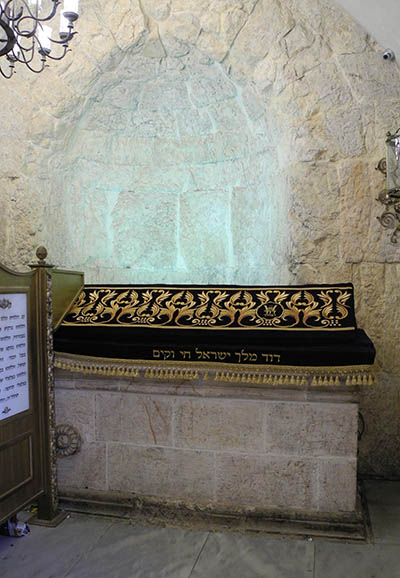
The grave of Nabi Dawud (AS) stands in the historic Maqam al-Nabi Dawud (مقام النبي داود) on Mount Zion, immediately south of Jerusalem’s Old City walls. Nabi…
The grave of Nabi Dawud (AS) stands in the historic Maqam al-Nabi Dawud (مقام النبي داود) on Mount Zion, immediately south of Jerusalem’s Old City walls. Nabi Dawud (AS) was a Prophet, ruler and judge among Bani Isra’il, and the father of Nabi Sulayman (AS). The Qur’an relates that Nabi Dawud (AS) killed Jalut, after which Allah gave him kingship and wisdom. “So they defeated them by Allah’s Will, and David killed Goliath. And Allah blessed David with kingship and wisdom and taught him what He willed.” Surah al-Baqarah 2:251 Nabi Dawud in Jerusalem Allah revealed the Zabur to Nabi Dawud (AS) and commanded him to judge between people with truth. The Qur’an also describes the mountains and birds joining his praise of Allah, and records that iron was made pliable for him so that he could fashion coats of armour. Nabi Sulayman (AS) inherited from Nabi Dawud (AS), continuing a prophetic household closely connected with Jerusalem. The maqam lies outside Bab al-Nabi Dawud, the gate commonly known as Zion Gate. Medieval Jerusalem chronicler Mujir al-Din al-Ulaymi recorded the names Qabr al-Nabi Dawud and Qabu al-Nabi Dawud for the site. The grave occupies a lower hall within a larger complex whose upper chamber is connected in Christian tradition with Nabi Isa (AS) and his disciples. The mosque and the Dajani custodians The present complex contains fabric from several periods. Muslim control of the building is documented in the Ayyubid period, in 615–616 AH/1219, when a mihrab was installed in the lower hall associated with Nabi Dawud (AS). Further parts of the complex developed under the Mamluks and Ottomans. Sultan Sulayman the Magnificent became the principal Ottoman patron of the maqam. In 1529 he appointed Shaykh Ahmad al-Dajani as its custodian, beginning the long association between the Jerusalemite Dajani family and the waqf, an endowed religious property, of Nabi Dawud (AS). An Ottoman inscription dated to Shawwal 973 AH/May 1566 records work undertaken at the mosque during Sultan Sulayman’s reign.