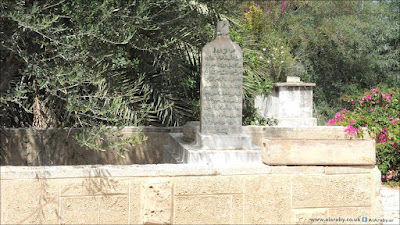
Sheikh Izz al-Din al-Qassam is buried here in Balad al-Sheikh, following his martyrdom in battle against British forces in 1935. Born in Jabla on the Syrian…
Sheikh Izz al-Din al-Qassam is buried here in Balad al-Sheikh, following his martyrdom in battle against British forces in 1935. Born in Jabla on the Syrian coast in 1882, Sheikh Izz al-Din al-Qassam (عزّ الدين القسّام) became a Muslim scholar, teacher and imam whose life joined religious education with resistance to colonial rule. His grave lies in the Muslim graveyard of Balad al-Sheikh, east of Haifa, within the area now administered as Nesher. From Jabla and al-Azhar to Haifa Sheikh Izz al-Din al-Qassam received his earliest education at his father’s kuttab, a Qur’anic elementary school, before travelling to Cairo as a young man to study at al-Azhar. After returning to Jabla, he taught reading, writing and Qur’an memorisation and became imam of the Mansuri Mosque. When Italy invaded Libya in 1911, he organised support for the Libyan resistance. He later joined the struggle against French rule on the Syrian coast in 1919–20. After the French authorities sentenced him to death, he left Syria with his family and companions and reached Haifa in late 1920. In Haifa, Sheikh Izz al-Din al-Qassam taught at the Burj school and delivered lessons at the Istiqlal Mosque. He later became the mosque’s imam and preacher and established night classes for adults who had not learned to read. He also helped found the Haifa branch of the Society of Muslim Youth and was elected its president in 1928. His appointment as a ma’dhun, an official authorised by the Shari‘a court to register marriages, took him through villages across the Galilee and brought him into close contact with rural communities. The battle near Ya‘bad During the British Mandate, Sheikh Izz al-Din al-Qassam organised resistance to British colonial rule and the growing dispossession of Palestinians. In November 1935, he left Haifa with a group of his followers and moved into the countryside near Ya‘bad in the Jenin district. British forces surrounded the group in the wooded hills on 20 November 1935. Sheikh Izz al-Din al-Qassam and several of his companions were martyred in the ensuing battle. His death preceded the Great Palestinian Revolt of 1936–39 and helped shape the movement that followed. The funeral at Balad al-Sheikh Haifa observed a general strike on 21 November 1935 as shops, restaurants and businesses closed for his funeral. Thousands joined the procession that carried Sheikh Izz al-Din al-Qassam and his martyred companions from Haifa to the Muslim graveyard at Balad al-Sheikh. The graveyard had been established by the Islamic waqf of Haifa shortly before his death. Balad al-Sheikh was a Palestinian village on the road between Haifa and Jenin; the village was depopulated in 1948, while its graveyard and the grave of Sheikh Izz al-Din al-Qassam remained.