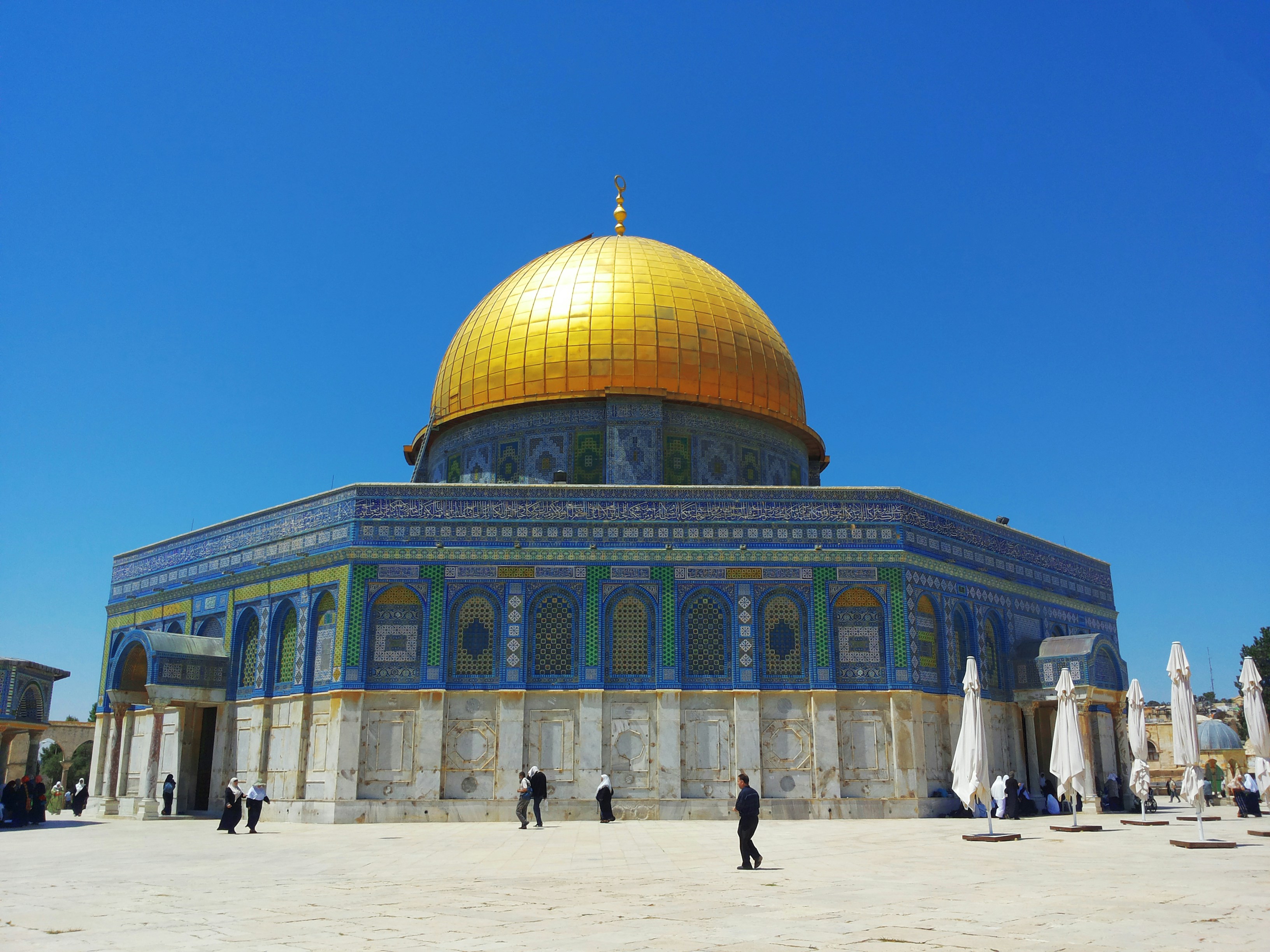
Qubbat al-Sakhra (قبة الصخرة) encloses the Noble Rock at the heart of Masjid al-Aqsa, the sanctuary in Jerusalem from which the Prophet Muhammad ﷺ made his…
Qubbat al-Sakhra (قبة الصخرة) encloses the Noble Rock at the heart of Masjid al-Aqsa, the sanctuary in Jerusalem from which the Prophet Muhammad ﷺ made his ascent during al-Isra wa’l-Mi‘raj. The building stands on the raised central platform of al-Haram al-Sharif in the Old City. In Islamic usage, Masjid al-Aqsa encompasses the entire walled sanctuary, including Qubbat al-Sakhra, the Qibli Mosque to its south, the courtyards, gates and other prayer spaces. The Night Journey and the Noble Rock Allah brought the Prophet Muhammad ﷺ by night from Masjid al-Haram in Makkah to Masjid al-Aqsa in Jerusalem. Islamic tradition holds that the Noble Rock, al-Sakhra al-Musharrafa, is the place from which the Prophet Muhammad ﷺ ascended through the heavens in the company of Sayyiduna Jibril (AS). “Glory be to the One Who took His servant ˹Muḥammad˺ by night from the Sacred Mosque to the Farthest Mosque whose surroundings We have blessed, so that We may show him some of Our signs. Indeed, He alone is the All-Hearing, All-Seeing.” Surah al-Isra 17:1 During the Night Journey, the Prophet Muhammad ﷺ prayed at Bayt al-Maqdis and led the assembled Prophets in prayer. The journey joined Makkah and Jerusalem within one Qur’anic narrative, while the Mi‘raj brought the Prophet Muhammad ﷺ through the heavens and culminated in the obligation of the five daily prayers. Masjid al-Aqsa had also been the first qibla, the direction faced by the Prophet Muhammad ﷺ and the early Muslim community in prayer before the qibla was changed to the Ka‘bah. Qubbat al-Sakhra therefore occupies ground bound to the Night Journey, the earlier Prophets and the earliest years of the Muslim community. The monument of Caliph Abd al-Malik The Umayyad caliph Abd al-Malik ibn Marwan commissioned Qubbat al-Sakhra, and its great inscription dates its completion to 72 AH/691–692. It is the earliest major Islamic monument to survive substantially in its original form. The building follows an octagonal plan centred upon the exposed rock. An inner ring of supports carries the wooden dome, while two surrounding passageways allow movement around al-Sakhra. The surviving seventh-century interior decoration includes glass mosaics formed from vegetal designs, crowns and jewelled motifs, without human or animal figures. A long Arabic inscription runs around the interior. Its words proclaim the oneness of Allah, name the Prophet Muhammad ﷺ as His servant and messenger, and set out the Qur’anic account of Nabi Isa ibn Maryam (AS), affirming him as a messenger of Allah and the son of Sayyidah Maryam. The inscription belongs to the earliest extensive surviving monumental uses of Qur’anic passages and Islamic declarations of faith. In 437 AH/1047, the Muslim traveller Nasir Khusraw recorded a detailed description of the sanctuary and Qubbat al-Sakhra. His account describes the rock at the building’s centre, the surrounding columns and piers, the ornamented surfaces and the inscriptions, preserving a view of the monument before later alterations. From the Crusader occupation to Salahuddin al-Ayubi After the Crusaders captured Jerusalem in 492 AH/1099, Qubbat al-Sakhra was converted into a church called the Templum Domini. Christian furnishings were installed around the rock, and the building became closely associated with the Knights Templar, whose headquarters occupied part of the wider sanctuary. Salahuddin al-Ayubi recovered Jerusalem in 583 AH/1187 and restored Qubbat al-Sakhra to Islamic worship. The Christian fittings were removed, the rock was uncovered, and renewed inscriptions and decoration marked the return of Masjid al-Aqsa to Muslim care. Later Ayyubid and Mamluk rulers supported the sanctuary through repairs, furnishings and waqf endowments, charitable trusts established for its maintenance and religious institutions. The tiles and later restorations Under the Ottoman sultan Suleiman, the exterior decoration was extensively renewed during the sixteenth century. Glazed ceramic tiles replaced the earlier exterior mosaics, introducing the blue, turquoise and white patterned surfaces that became one of the building’s defining features. Further Ottoman projects repaired the dome, windows and tilework in later centuries. The Islamic Higher Council undertook a major restoration during the 1920s with financial support from Sharif Hussein ibn Ali. Later Hashemite projects continued work on the structure and its decoration. Between 1992 and 1994, King Hussein of Jordan personally financed a restoration in which the outer covering of the dome was renewed with gilded metal plates. Qubbat al-Sakhra stands within the Old City of Jerusalem in Palestine, near the centre of Masjid al-Aqsa’s elevated platform. Its Umayyad plan, early Qur’anic inscriptions, interior mosaics and the Noble Rock preserve more than thirteen centuries of Islamic history within the sanctuary named in the Qur’an.