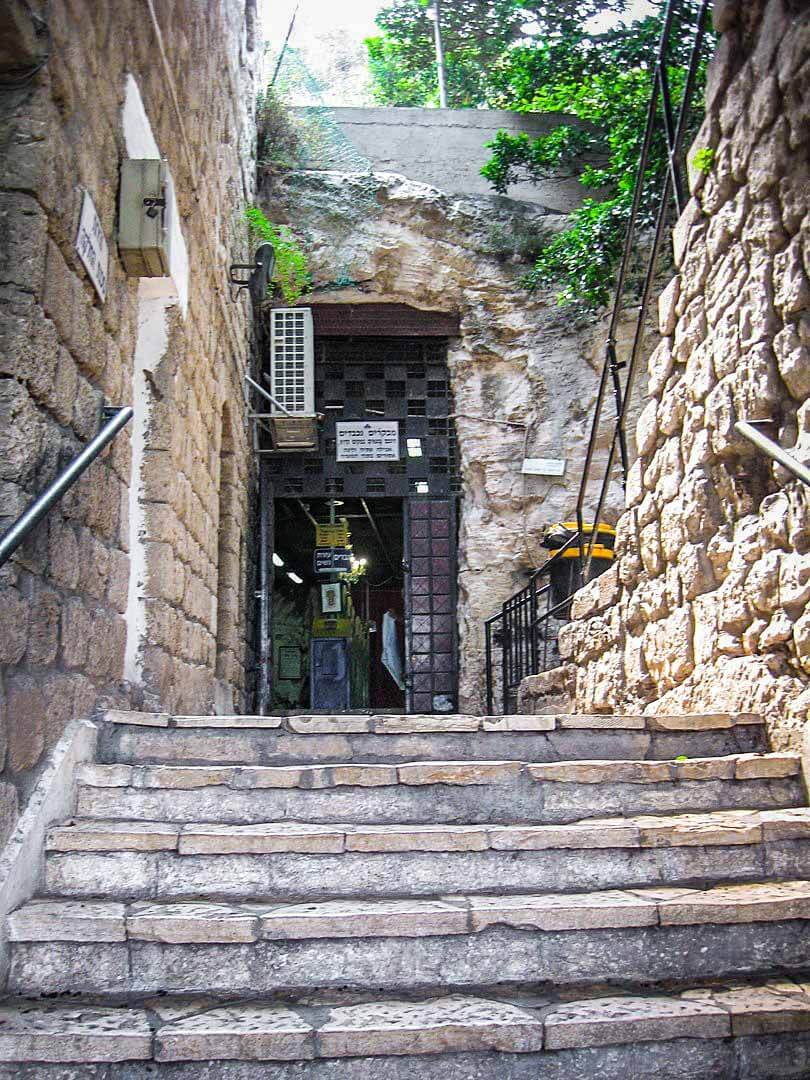
Tradition holds that Nabi Ilyas (AS) sheltered in this cave on Mount Carmel during persecution and prepared here for his confrontation with the worshippers of…
Tradition holds that Nabi Ilyas (AS) sheltered in this cave on Mount Carmel during persecution and prepared here for his confrontation with the worshippers of Ba‘l. Known in Arabic as مغارة الخضر, Magharat al-Khader, the cave lies near the foot of Mount Carmel’s northwestern slope in Haifa. It is the lower of two caves on the mountain associated with Nabi Ilyas (AS); another stands higher on the slope within the Stella Maris complex. Nabi Ilyas and the call against Ba‘l Nabi Ilyas (AS) was a Prophet sent among Bani Isra’il. The Qur’an names him among the messengers and preserves his call to abandon Ba‘l and return to the worship of Allah, the Lord of their forefathers. “Will you not fear ˹Allah˺? Do you call upon ˹the idol of˺ Ba’l and abandon the Best of Creators—Allah, your Lord and the Lord of your forefathers?” Surah al-Saffat 37:124–126 The Qur’an relates that his people rejected him, while honouring Nabi Ilyas (AS) as one of Allah’s faithful servants. Tradition places episodes from this struggle on Mount Carmel, where the cave became closely joined to his name. Magharat al-Khader on Mount Carmel Accounts of the cave appear in travellers’ writings from the medieval period onward. In the seventeenth century it was converted into a mosque, while remaining known among Muslims, Christians, Jews and Druze. In Muslim usage it was called al-Khader, a name also found in the pre-1948 endowment Waqf al-Khader, administered by the Hajj Ibrahim family of Haifa. Archaeological surveys have recorded numerous inscriptions cut into the cave walls in Greek, Hebrew, Arabic and Latin. These writings preserve evidence of the site’s long history before its later association with several religious communities.