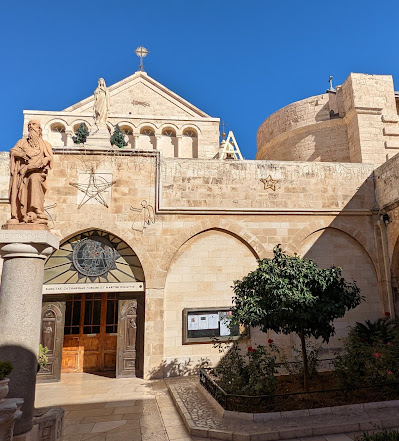
This is the place in Bethlehem understood to be where Nabi Isa ibn Maryam (AS) was born, with the Church of the Nativity built above the cave marking his…
This is the place in Bethlehem understood to be where Nabi Isa ibn Maryam (AS) was born, with the Church of the Nativity built above the cave marking his birth. Known in Arabic as كنيسة المهد, the church stands in Bethlehem, Palestine, south of al-Quds. Its identification with the birth of Nabi Isa ibn Maryam (AS) was already established by the second century, while the first major church over the cave was completed in 339 CE. Sayyidah Maryam and the birth of Nabi Isa The Qur’an relates that Sayyidah Maryam withdrew from her people after conceiving Nabi Isa (AS) by Allah’s command. When the pains of labour brought Sayyidah Maryam to the trunk of a palm tree, Allah provided water and fresh dates for her. “And the pains of childbirth drove her to the trunk of a palm tree. She said, ‘Oh, I wish I had died before this and was in oblivion, forgotten.’ But he called her from below her, ‘Do not grieve; your Lord has provided beneath you a stream. And shake toward you the trunk of the palm tree; it will drop upon you ripe, fresh dates.’” Surah Maryam 19:23–25 Nabi Isa ibn Maryam (AS) was born without a father and spoke while still in the cradle, declaring himself a servant of Allah. Allah sent Nabi Isa (AS) to Bani Isra’il, gave him the Injil and supported him with signs: he healed the blind and the leper and raised the dead by Allah’s permission. The Qur’an states that Nabi Isa (AS) was neither killed nor crucified, but was raised by Allah. The Prophet ﷺ prayed at Bethlehem Bethlehem also enters the Seerah through the journey of al-Isra wa’l-Mi‘raj. Sunan an-Nasa’i records that Sayyiduna Jibril (AS) instructed the Prophet Muhammad ﷺ to dismount and pray at several places on the route to Bayt al-Maqdis, explaining the history of each location. “Then he said: ‘Dismount and pray,’ so I prayed. He said: ‘Do you know where you have prayed? You have prayed in Bethlehem, where Isa, peace be upon him, was born. Then I entered Bayt al-Maqdis (Jerusalem) where the Prophets, peace be upon them, were assembled for me, and Jibril brought me forward to lead them in prayer.’” Sunan an-Nasa’i 450 The narration places Bethlehem within the sacred geography of the Night Journey, alongside Taybah—the future place of the Prophet’s ﷺ hijra—and Tur Sina, where Allah spoke to Nabi Musa (AS). From Bethlehem, the Prophet ﷺ continued to Bayt al-Maqdis, where the Prophets assembled and he led them in prayer. The church above the cave The first church was arranged around the cave associated with the birth of Nabi Isa ibn Maryam (AS). After that building was damaged by fire, the Byzantine emperor Justinian commissioned the sixth-century church that forms the main body of the present structure. Parts of the mosaic floor belonging to the earlier fourth-century church survive beneath it. The cave lies below the eastern part of the church. A silver star set into the floor marks the place understood to be the point of the birth. The wider complex includes Greek Orthodox, Armenian and Latin churches and convents, while the adjoining route through Bethlehem preserves the old approach to the site. The Church of the Nativity and Bethlehem’s historic pilgrimage route were inscribed on the UNESCO World Heritage List in 2012. The church is administered through the long-established arrangement shared by the Greek Orthodox Church, the Armenian Apostolic Church and the Roman Catholic custodians of the adjoining Franciscan foundation.