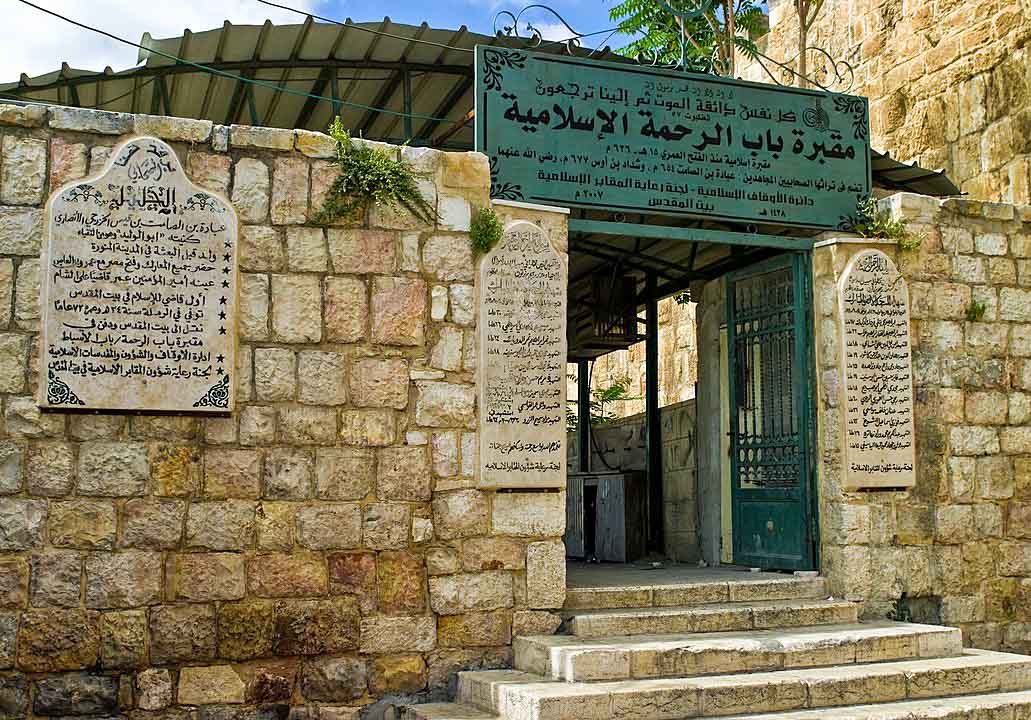
Two Companions of the Prophet Muhammad ﷺ are buried in Maqbarat Bab al-Rahmah (مقبرة باب الرحمة), the historic Muslim graveyard beside the eastern wall of…
Two Companions of the Prophet Muhammad ﷺ are buried in Maqbarat Bab al-Rahmah (مقبرة باب الرحمة), the historic Muslim graveyard beside the eastern wall of al-Masjid al-Aqsa in Jerusalem. The graveyard takes its name from Bab al-Rahmah, the southern opening of the sealed double gateway above it; the northern opening is Bab al-Tawbah, the Gate of Repentance. Jerusalem’s Awqaf dates the present gateway to the Umayyad period. The burial ground runs along the outer side of al-Aqsa’s eastern wall, facing the Mount of Olives across the Kidron Valley. The graves of two Companions Sayyiduna Ubadah ibn al-Samit (RA) was one of the Ansar of Madinah, one of the representatives at al-Aqabah and a participant at Badr. Al-Dhahabi records that he settled in Bayt al-Maqdis and was among the Companions sent into al-Sham during the caliphate of Sayyiduna Umar ibn al-Khattab (RA) to teach the Qur’an and Islamic knowledge. He died in 34 AH and was buried in Jerusalem; his grave stands in Bab al-Rahmah Graveyard. Sayyiduna Shaddad ibn Aws (RA), a nephew of the poet Sayyiduna Hassan ibn Thabit (RA), also made his home in Bayt al-Maqdis. Muslim biographers describe him as a learned Companion and narrator of hadith whose descendants lived in the city. He died there in 58 AH, and his grave stands beside the eastern wall within the same graveyard. A graveyard beside Masjid al-Aqsa Bab al-Rahmah Graveyard also contains graves associated with the early Muslim entry into Jerusalem and with the city’s recovery under Salahuddin al-Ayubi. Later Jerusalemite families continued to bury their dead on this ground, joining the city’s history directly to the wall of al-Masjid al-Aqsa. The roadway approaching Bab al-Asbat marks the northern end of Bab al-Rahmah Graveyard. Beyond it lies the adjoining al-Yusufiyyah graveyard, also known as the Bab al-Asbat Graveyard.