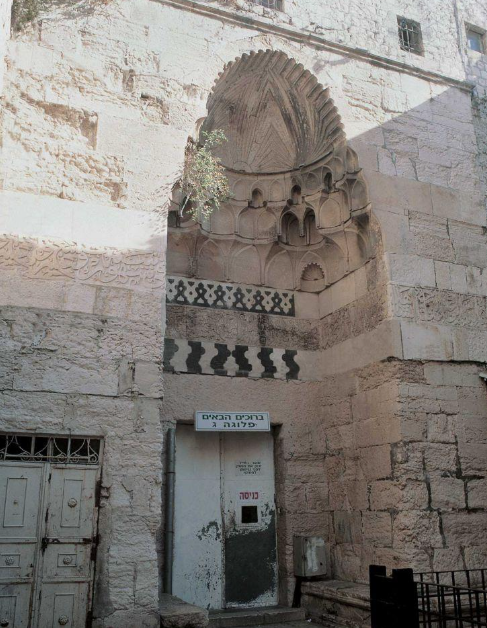
Founded in 729 AH / 1328–29 CE beside Bab al-Silsila, al-Tankiziyya Madrasa was one of Mamluk Jerusalem’s principal institutions for Islamic learning, hadith…
Founded in 729 AH / 1328–29 CE beside Bab al-Silsila, al-Tankiziyya Madrasa was one of Mamluk Jerusalem’s principal institutions for Islamic learning, hadith and spiritual retreat. Known in Arabic as المدرسة التنكزية, the complex stands on Tariq Bab al-Silsila at the western boundary of al-Masjid al-Aqsa. Its ground level adjoins the Sanctuary wall, while part of its upper storey extends above the western portico near Bab al-Silsila. The foundation of Amir Tankiz The madrasa was founded as a waqf, an endowed charitable institution, by Amir Sayf al-Din Tankiz al-Nasiri. Tankiz governed Bilad al-Sham for Sultan al-Nasir Muhammad ibn Qalawun from 712 to 740 AH / 1312 to 1340 CE and became one of the leading architectural patrons of fourteenth-century Jerusalem. His projects around al-Masjid al-Aqsa included Suq al-Qattanin and its gate, completed in 737 AH / 1336–37 CE. These foundations joined commerce to religious and educational life: income-producing properties supported institutions such as al-Tankiziyya and the people appointed to teach, administer and reside within them. The madrasa’s foundation inscription records Tankiz as its patron and dates the building to 729 AH. Three cup emblems divide the inscription above the entrance. The cup was Tankiz’s heraldic device, connected with his former court office as cupbearer. A madrasa, khanqah and house of hadith Al-Tankiziyya combined several functions within one endowed complex. It housed a madrasa for Islamic teaching, a house devoted to hadith studies and a khanqah, a residence organised for worship and spiritual retreat. Rooms accommodated students and other residents, while adjoining shops formed part of the property associated with the foundation. The building is arranged across a ground floor, mezzanine and upper storey. Its entrance from Bab al-Silsila Street leads through a vestibule into a central courtyard with four axial iwans. The southern iwan contains the mihrab, while the upper rooms include an assembly hall built partly above the western portico of al-Masjid al-Aqsa. The northern entrance preserves characteristic Mamluk stonework, muqarnas and the dated inscription. Inside, documented features include marble paving, a central fountain and a mihrab faced with marble panels carrying geometric and vegetal decoration. From teaching to the Shari‘a court During the Mamluk period, al-Tankiziyya also became associated with Jerusalem’s judiciary. Under Ottoman rule it housed the city’s Shari‘a court and consequently became widely known as al-Mahkama, “the court.” Its court records belonged to the documentary life of Jerusalem, preserving legal transactions, waqf affairs and cases brought before the city’s judges. In the early British Mandate period the Supreme Muslim Council used the building as a residence, and it later returned to educational use as a school for Islamic jurisprudence. The Jerusalem Islamic Waqf records that the complex has been used as a police post since 1969.