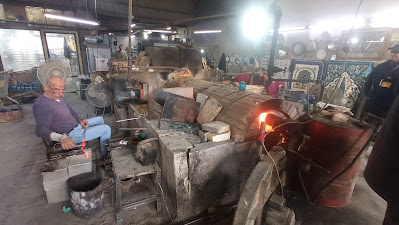
Glass has been blown in al-Khalil (Hebron) since the medieval period, and the city's name has travelled with it — cobalt, turquoise, green and amber pieces…
Glass has been blown in al-Khalil (Hebron) since the medieval period, and the city's name has travelled with it — cobalt, turquoise, green and amber pieces carried out by pilgrims and traders, and the small ringed glass bracelets sold across Palestine, Egypt and the Hijaz for centuries. Al-Khalil Glass & Ceramics Factory, on Ras al-Jora Street at the northern entrance to the city, is the best known of the few workshops still keeping that craft alive. A Palestinian craft The trade grew from what the land gave: silica-rich sand quarried in the hills around the city, soda from plant ash, and furnaces fed by whatever fuel was to hand. Travellers passing through Ottoman Palestine wrote of the glass houses of al-Khalil, and Hebron glass became one of the few Palestinian manufactures known well beyond its own region, alongside Nablus soap and Gaza weaving. Much of the craft was lost through the twentieth century as imported glass undercut it and workshops closed. What survives is worked the same way it always was — by lung and hand, at the end of a steel pipe, in front of anyone who walks in. The workshop at Ras al-Jora The Natsheh family have blown glass in the city for generations and opened their Old City workshop in 1890, moving the furnaces out to Ras al-Jora when the old quarter became difficult to work in, and adding ceramics in 1962. Today the raw material is recycled bottles and broken glass, sorted by colour and returned to a furnace held at around 1,000°C. The blower gathers a glowing lump, blows it out on the marver, then turns, pulls and cuts it into jugs, goblets, lamps, bowls and bracelets. The faint waves and bubbles are left in rather than worked out — they are how Hebron glass is recognised. The family also produce work in the older Phoenician style, with its swirled bands of colour. The ceramics side moulds, dries and fires each piece before it is hand-painted and glazed, in floral and geometric patterns long used in Palestinian pottery. The showroom at the front carries the full range, and the furnace room is open to watch.