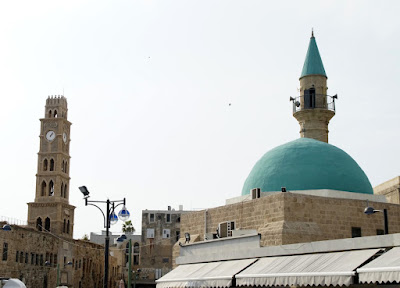
Masjid al-Jazzar in Akka preserves blessed hairs from the beard of the Prophet Muhammad ﷺ in one of Palestine’s great Ottoman mosques. Known in Arabic as جامع…
Masjid al-Jazzar in Akka preserves blessed hairs from the beard of the Prophet Muhammad ﷺ in one of Palestine’s great Ottoman mosques. Known in Arabic as جامع الجزار, the mosque was built in 1781 by Ahmad Pasha al-Jazzar, the Ottoman governor who made the fortified Palestinian port city the centre of his rule. Ahmad Pasha al-Jazzar is buried in the mosque courtyard, alongside his successor Sulayman Pasha al-Adil, who governed from Akka until his death in 1819. The blessed hairs of the Prophet Muhammad ﷺ The mosque holds several blessed hairs from the beard of the Prophet Muhammad ﷺ, preserved in a glass case. Their arrival in Akka is connected with Sultan Abdul Hamid II, who presented them to Shaykh Asad al-Shuqayri, an Akka scholar and member of the Ottoman parliament. Accounts from Akka record that the blessed hairs were formerly carried through the city in a public procession on Eid al-Fitr. In later practice they were displayed within the mosque on occasions including Eid and Laylat al-Qadr, the Night of Decree during Ramadan. Ahmad Pasha al-Jazzar and Ottoman Akka Ahmad Pasha al-Jazzar governed the Ottoman province of Sidon from Akka and directed an extensive programme of construction in the city. The mosque formed the centre of a larger endowed complex containing al-Madrasa al-Ahmadiyya, accommodation for students, a library and an Islamic court. The mosque’s green lead-covered dome, minaret and arcaded courtyard belong to the Ottoman rebuilding that shaped much of the present Old City. Stones for the complex were brought from sites including Caesarea and Atlit, while rooms around the courtyard housed students of al-Madrasa al-Ahmadiyya until 1948. Ahmad Pasha al-Jazzar also led Akka’s defence during the French siege of 1799. The resistance of his forces and the city’s inhabitants forced Napoleon Bonaparte to abandon the siege after two months, halting the French advance through Palestine. The library of al-Madrasa al-Ahmadiyya Ahmad Pasha al-Jazzar endowed the mosque library with more than 1,800 volumes, making it one of the largest Islamic libraries established in Ottoman Palestine before the twentieth century. Its manuscripts covered Qur’anic studies, hadith, Islamic law, Arabic language and literature, logic and mathematics. A surviving group of manuscripts remains attached by waqf, an Islamic charitable endowment, to al-Madrasa al-Ahmadiyya. The collection includes Arabic manuscripts copied between the fourteenth century and the end of Ottoman rule, together with a manuscript in Ottoman Turkish.