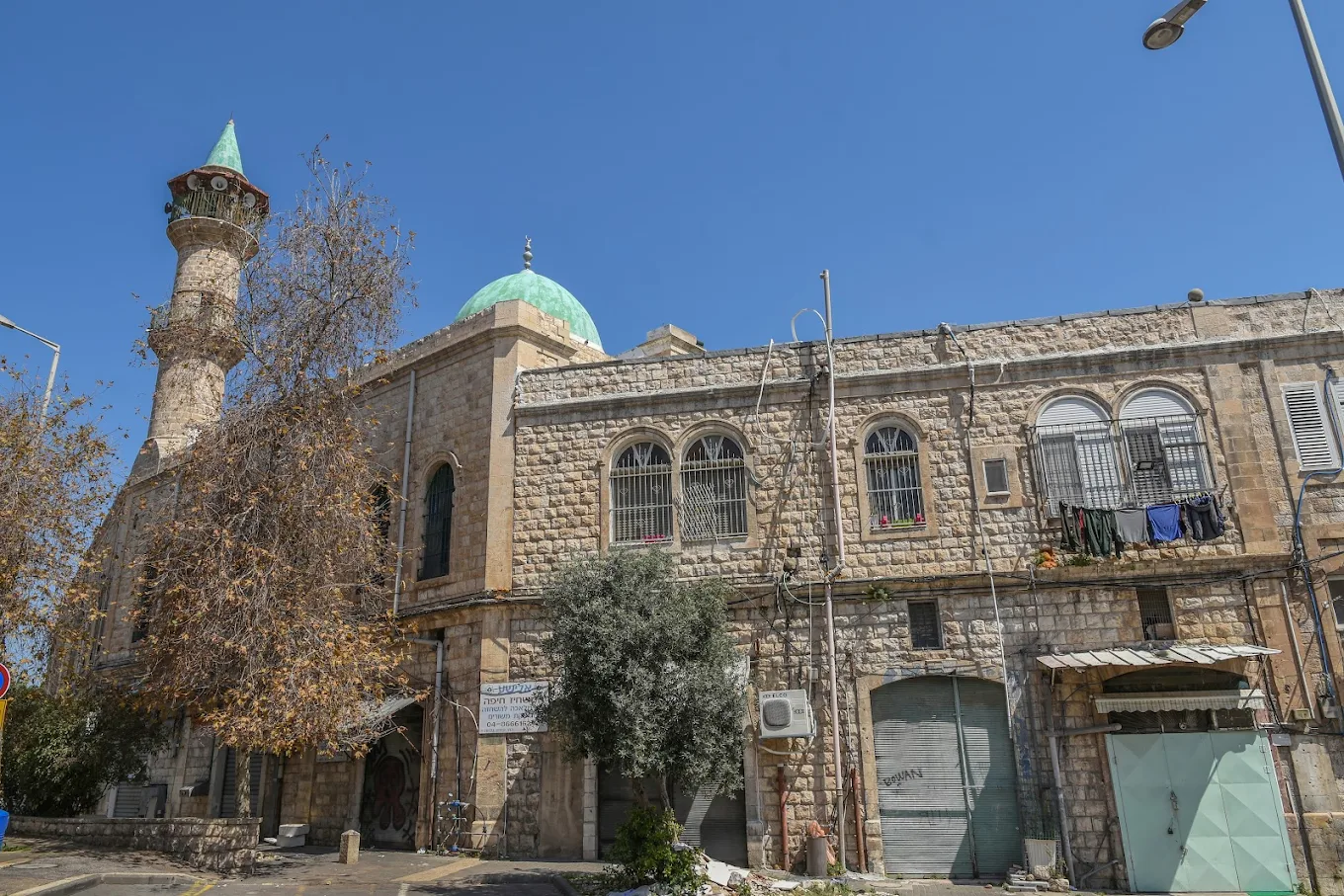
Built by Haifa’s Muslim community in the 1920s, al-Istiqlal Mosque became the pulpit of Shaykh Izz al-Din al-Qassam and a centre of Muslim life in the city.…
Built by Haifa’s Muslim community in the 1920s, al-Istiqlal Mosque became the pulpit of Shaykh Izz al-Din al-Qassam and a centre of Muslim life in the city. Known in Arabic as جامع الاستقلال, Jami‘ al-Istiqlal, its name means the Mosque of Independence. It stands in Haifa’s historic lower city, near Wadi al-Salib and the old commercial quarters that expanded rapidly during the British Mandate. The mosque built by Haifa’s Muslim Association Haifa’s Muslim Association was founded in 1337 AH/1919 to administer the city’s Islamic waqf, an endowment maintained for religious and communal purposes. The association established al-Burj Islamic School and later formed a committee to build a new congregational mosque for Haifa’s growing Muslim population. An inscription records that the foundation stone was laid on 1 Muharram 1342 AH, corresponding to 14 August 1923. The following month, Shaykh Muhammad Murad, the mufti of Haifa and a member of the Supreme Muslim Council, requested support for the work. The council approved a contribution of 200 Egyptian pounds on 22 September 1923. Construction continued through the middle of the decade, and the mosque opened for congregational prayer in 1925. The pulpit of Shaykh Izz al-Din al-Qassam Shaykh Izz al-Din al-Qassam came from Jabla on the Syrian coast and had studied at al-Azhar. After taking part in resistance to French colonial rule in Syria, he settled with his family in Haifa around 1920 and taught at al-Burj School. When al-Istiqlal Mosque opened, Shaykh Izz al-Din al-Qassam became its imam, khatib and teacher. His sermons addressed the religious and social concerns of Haifa’s workers and poorer families, while his night school provided adult literacy teaching. The surviving minbar from which he delivered his khutbahs is one of the mosque’s principal historic features. Shaykh Izz al-Din al-Qassam later organised resistance to British colonial rule and Zionist settlement. He was martyred with members of his group near Ya‘bad in November 1935 and was buried in the graveyard of Balad al-Shaykh in the Haifa district. His death helped shape the events leading into the Great Palestinian Revolt of 1936–1939. The mosque after the Nakbah The displacement of most of Haifa’s Palestinian population during the Nakbah of 1948 disrupted the institutions that had supported the mosque. Renovation work undertaken in the following decades enabled al-Istiqlal to resume its place as one of Haifa’s principal working mosques. Egyptian president Anwar Sadat prayed here during his September 1979 visit to Haifa, after arriving at the city’s port aboard the presidential yacht. The mosque continues to preserve the foundation inscription, the historic entrance and staircase, and the minbar associated with Shaykh Izz al-Din al-Qassam.