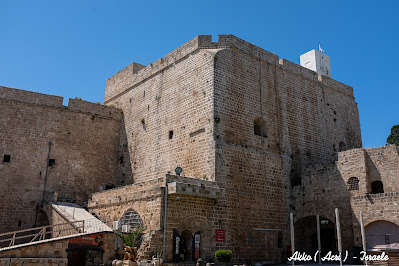
Acre Citadel was the Ottoman seat of government in the fortified Palestinian port of Acre, rebuilt as a centre of power during the eighteenth century. Known…
Acre Citadel was the Ottoman seat of government in the fortified Palestinian port of Acre, rebuilt as a centre of power during the eighteenth century. Known in Arabic as قلعة عكا, Qal‘at ‘Akka, the citadel occupies the northern part of Acre’s Old City. The Ottoman complex was raised over a twelfth-century Hospitaller fortress, whose surviving halls lie beneath the later buildings. Acre’s place in Islamic maritime history Acre entered Muslim rule during the conquest of Bilad al-Sham and became a port of Jund al-Urdunn. Its harbour gave Muslim fleets access to the eastern Mediterranean and made the city strategically important long before the present citadel was built. In the ninth century, Ahmad ibn Tulun ordered Acre’s maritime defences to be strengthened after inspecting the fortified harbour of Tyre. The geographer al-Muqaddasi records that his grandfather, the Jerusalem architect Abu Bakr al-Banna, was summoned to undertake the difficult construction in the sea. Salahuddin al-Ayubi recovered Acre after the Battle of Hattin in 583 AH/1187. The city fell again after the long siege of 585–587 AH/1189–1191, despite efforts by Salahuddin al-Ayubi to support its Muslim garrison. In 690 AH/1291, the Mamluk sultan al-Ashraf Khalil captured Acre, ending its role as the last major Crusader stronghold on the Palestinian coast. The citadel of Zahir al-Umar and Ahmad Pasha al-Jazzar Acre regained its position as a major city under Zahir al-Umar al-Zaydani, the eighteenth-century Palestinian ruler who made it his capital. He rebuilt and fortified Acre, developed its commerce and incorporated the earlier fortress site into the new seat of government. Ahmad Pasha al-Jazzar succeeded Zahir al-Umar in Acre in 1775 and expanded the citadel as the headquarters of his administration. From here he governed Sidon Province and directed the defence of the city during Napoleon Bonaparte’s siege in 1213 AH/1799. Acre held out, forcing the French army to abandon its advance through Palestine. The citadel initially served Acre’s Ottoman governors as a palace and government compound. It was later used as a military barracks, armoury and prison, while the surrounding Ottoman city included the mosque, markets, khans and hammam established under Ahmad Pasha al-Jazzar and his successors. From government compound to prison During the British Mandate in Palestine, the citadel became the principal prison in the north. Palestinian detainees were held here, including men imprisoned during the Palestinian uprising of 1936–1939. Fuad Hijazi, ‘Ata al-Zir and Muhammad Khalil Jamjum were executed in the prison on 17 June 1930, an event remembered in Palestinian poetry and public history. The upper citadel now contains a museum devoted chiefly to the prison and Jewish underground organisations of the Mandate period. Archaeological excavation beneath the Ottoman compound exposed much of the earlier Hospitaller complex, preserving two major periods of Acre’s history within the same site. The Old City of Acre, including the citadel, was inscribed as a UNESCO World Heritage Site in 2001.