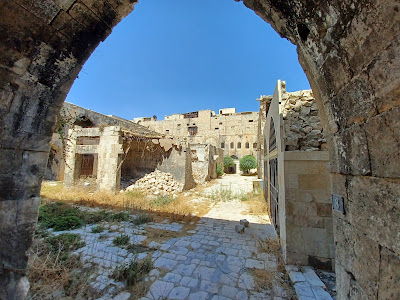
Khan al-Sabun, often called the jewel of Aleppo’s khans, is considered one of the most beautiful monuments from the Mamluk era in the city. Situated within…
Khan al-Sabun, often called the jewel of Aleppo’s khans, is considered one of the most beautiful monuments from the Mamluk era in the city. Situated within the historic al-Madina Souks, between the Soap Market and the Goldsmiths' Market, the khan was commissioned by Prince Azdamur ibn Mazid (d. 899 AH / 1493 CE). The khan follows the traditional design of Aleppo’s caravanserais, with a central courtyard surrounded by arcades and rooms on two floors: the lower level once housed storage areas and display spaces for merchants, while the upper level provided lodging for traders visiting the city. In the early 20th century, part of its northern side was removed to open the street leading from the Great Umayyad Mosque to the Citadel of Aleppo. The remaining façade, however, retains its magnificent Mamluk decorative elements—including intricate floral and geometric motifs, calligraphy, inscriptions, and touches of gilding, making it one of the finest surviving examples of its kind. Although the interior has suffered damage due to improper use over time, the exterior façade of Khan al-Sabun remains a celebrated highlight of Aleppo’s architectural heritage.