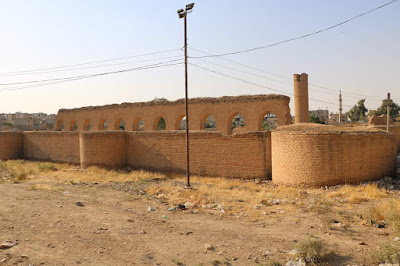
The Great Mosque of Raqqa, located within the historic city walls, was originally constructed in 155 AH / 773 CE during the reign of the Abbasid Caliph…
The Great Mosque of Raqqa, located within the historic city walls, was originally constructed in 155 AH / 773 CE during the reign of the Abbasid Caliph al-Mansur. The mosque is notable for its monumental dimensions, measuring 112.6 by 97.3 metres, and for being one of the earliest surviving mosques of the Abbasid period in Syria. The mosque features a nearly square courtyard surrounded on three sides by double arcades, while the southern prayer hall (qibla riwaq) is divided into three aisles by two rows of columns. Entry into the mosque is through seven doorways: two in the west wall, two in the east, and three in the north. The mosque underwent significant restoration in 561 AH / 1166 CE under the patronage of Nur al-Din Zangi, a prominent ruler of the Zengid dynasty. This is confirmed by an inscription located on the façade of the qibla wall. One of the mosque’s most distinguishing features is its freestanding minaret, which is built on a square stone base and stands in the courtyard, slightly apart from the main prayer hall. The cylindrical structure is decorated only with a vertical row of arrow-slit windows, topped by four arched windows, giving it a stark yet powerful presence. The style of this minaret closely resembles that of the nearby Qal‘at Ja‘bar, another structure commissioned by Nur al-Din, linking the two architecturally and historically. The mosque stands as an important testament to Abbasid and Zengid architecture and the historical importance of Raqqa as a political and cultural centre in early Islamic Syria.