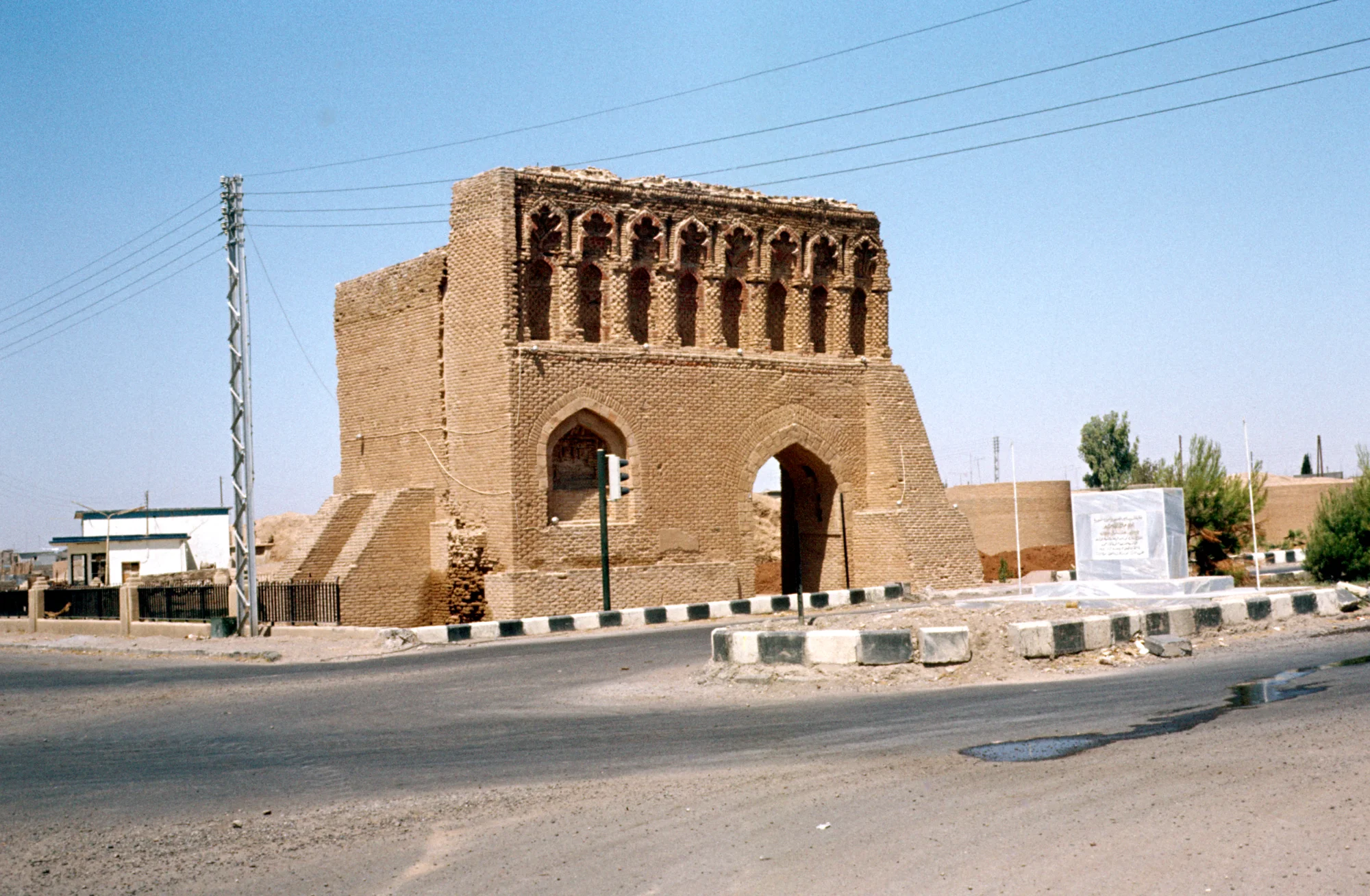
Bab Baghdad is the only surviving gate from the original city walls of al-Raqqa, a prominent Abbasid-era city in northeastern Syria. Built during the 8th…
Bab Baghdad is the only surviving gate from the original city walls of al-Raqqa, a prominent Abbasid-era city in northeastern Syria. Built during the 8th century CE under the Abbasid Caliphate, the gate is located on the southeastern corner of the city’s massive fortification wall, which was originally surrounded by a 16-metre-wide moat. The gate served as the main eastern entrance to the city, leading toward Baghdad, hence its name. The structure is a striking example of Abbasid military architecture, measuring approximately 11.3 metres wide by 3.19 metres deep, with walls 8.5 metres thick. It is constructed entirely of baked brick, a hallmark of Mesopotamian craftsmanship. A Persian horseshoe arch crowns the main gateway, symbolising the architectural fusion between Persian and Arab styles that defined much of Abbasid-era urban design. Notably, the gate features two decorative mihrabs flanking the main passage, with an upper band of smaller niche-shaped mihrabs across the tower façade. This ornamental technique recalls similar motifs used in Umayyad palaces, highlighting a continuity and adaptation of earlier Islamic styles into the Abbasid visual lexicon. Bab Baghdad originally connected to a bridge that spanned the moat, providing secure entry into the fortified city. Though the corresponding Gate of Raha on the opposite end of the wall has not survived, Bab Baghdad remains one of the most significant architectural remnants of Abbasid al-Raqqa, testifying to the city’s past importance as a military, administrative, and cultural hub.