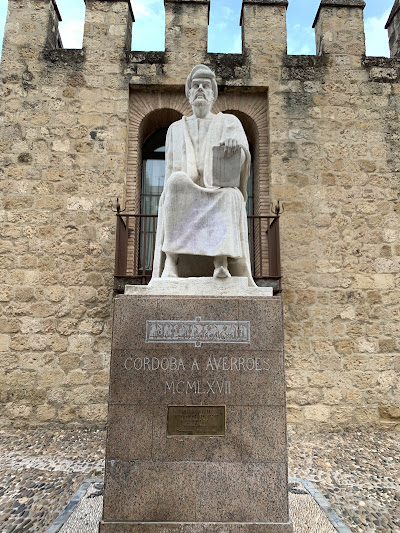
The statue of Abu al-Walid Muhammad ibn Ahmad ibn Rushd (Averroes, 1126–1198) stands in Córdoba to honour one of the most influential philosophers and jurists…
The statue of Abu al-Walid Muhammad ibn Ahmad ibn Rushd (Averroes, 1126–1198) stands in Córdoba to honour one of the most influential philosophers and jurists of the Islamic world. Born in Córdoba, Ibn Rushd was a qadi (judge), physician, philosopher, and commentator, best known in the West as “Averroes.” His extensive works on Aristotle, Islamic law, medicine, and theology bridged the intellectual traditions of Islam and Europe, leaving a lasting impact on both. Ibn Rushd served as a court physician and judge under the Almohads, but he is most remembered for his commentaries on Greek philosophy, which were later translated into Latin and Hebrew, shaping medieval European thought and earning him the title “the Commentator.” He also authored works on medicine, astronomy, jurisprudence, and theology, showing the breadth of Córdoba’s intellectual life. The statue is located in the Jewish Quarter (Judería) of Córdoba, near the Puerta de Almodóvar, not far from the historic centre. Its placement symbolises the city’s golden age of learning and convivencia, when Córdoba was a hub where Muslim, Christian, and Jewish scholars engaged in dialogue and exchange. The monument reminds visitors of Córdoba’s role as a cradle of knowledge and of Ibn Rushd’s enduring legacy as a thinker who championed reason, scholarship, and truth.