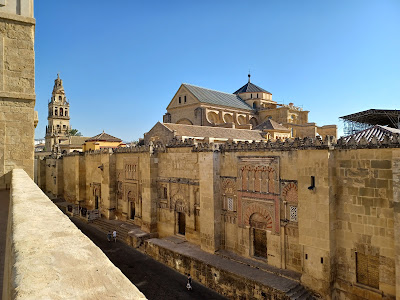
The Episcopal Palace of Córdoba, located directly opposite the Great Mosque–Cathedral, occupies a site of great historical depth. Before becoming the…
The Episcopal Palace of Córdoba, located directly opposite the Great Mosque–Cathedral, occupies a site of great historical depth. Before becoming the residence of Córdoba’s bishops after the Christian conquest in 1236, this location was part of the Umayyad Caliphal complex, closely tied to the political and religious centre of the city. Archaeological studies have revealed the remains of Roman, Visigothic, and Islamic structures beneath the palace, including parts of the Umayyad alcázar. The current palace was built and remodelled between the 14th and 18th centuries, giving it a mixture of Gothic, Renaissance, and Baroque elements. Yet its courtyards, arches, and water features echo the Andalusí tradition of palace design, where open patios and gardens formed the heart of domestic and administrative life. Today, the palace serves not only as the bishop’s residence but also as a cultural venue, housing the Museum of Diocesan Fine Arts (Museo Diocesano de Bellas Artes). For visitors, the Episcopal Palace represents a living example of Córdoba’s layered heritage: a Christian institution built directly upon the footprint of the city’s Islamic and earlier past, reflecting the continuity of Córdoba’s urban and architectural history.