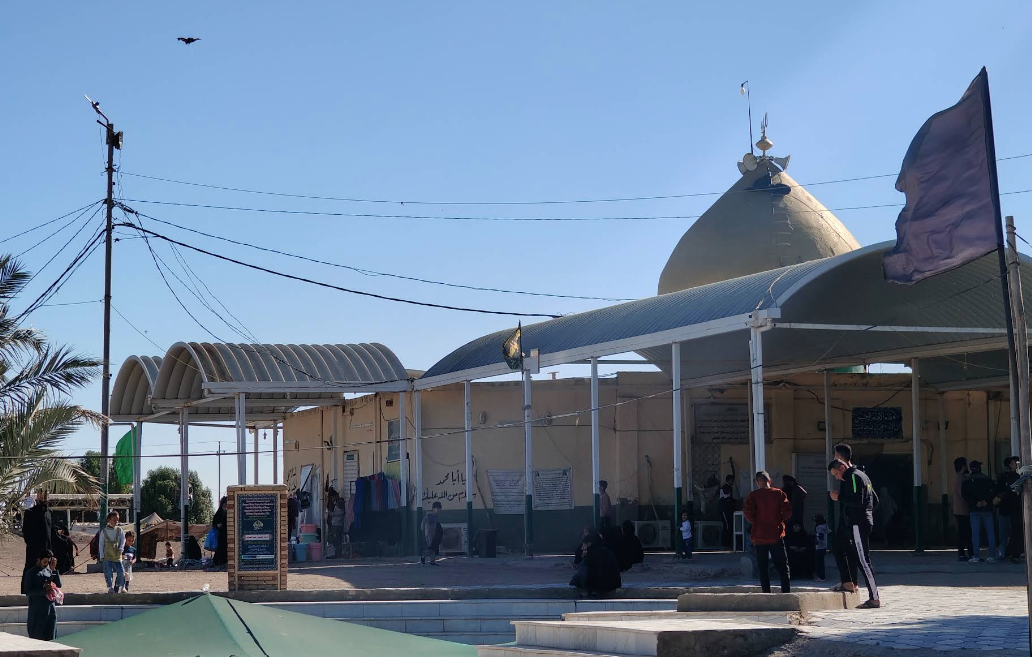
A historic maqām and natural spring in the al-Ḥīrah area near Najaf, believed to mark a place associated with the journey of Imam al-Ḥasan ibn ʿAlī al-Mujtabā…
A historic maqām and natural spring in the al-Ḥīrah area near Najaf, believed to mark a place associated with the journey of Imam al-Ḥasan ibn ʿAlī al-Mujtabā (RA), the beloved grandson of Nabi Muḥammad ﷺ. The site is not a grave. Imam al-Ḥasan (RA) is buried in Jannat al-Baqīʿ in Madinah. Rather, the maqām commemorates his believed presence or passage through this area. HISTORICAL ASSOCIATION WITH IMAM AL-ḤASAN (RA) Following the events of 41 AH, Imam al-Ḥasan (RA) left Kufa and travelled towards Madinah together with members of his family and household. Historical reports state that when he reached Dayr Hind, an ancient monastery in the al-Ḥīrah area, he looked back towards Kufa before continuing his journey to Madinah. A related historical account records that Imam al-Ḥusayn (RA), who was travelling with him, also looked back towards Kufa after they had passed Dayr Hind. These reports provide an important historical basis for associating the wider al-Ḥīrah area with the departure of Imam al-Ḥasan and members of the Ahl al-Bayt from Kufa. THE MAQĀM The principal structure at the site is known as the Maqām of Imam al-Ḥasan (RA). It is understood as a commemorative maqām marking the place where Imam al-Ḥasan is traditionally believed to have stopped or passed during his journey, rather than a burial place. Earlier field investigations documented a small domed shrine at the location containing a marker associated with the Imam's presence. ʿAYN AL-ḤASAN — THE SPRING Beside the maqām is a natural water source traditionally known as ʿAyn al-Ḥasan — عين الحسن, meaning the Spring of al-Ḥasan. The water source has also been described locally as ʿAyn al-Istishfāʾ, or the “healing spring,” and some modern listings refer to it as the Well of Imam Hasan. The spring has been associated with Imam al-Ḥasan locally for generations. An Iraqi account describing a visit to the area in 1355 AH, approximately 1936–37, already records the water source being known as ʿAyn al-Ḥasan and people gathering around it. DID IMAM AL-ḤASAN DIG THE WELL? Some later local traditions state that Imam al-Ḥasan (RA) personally dug the well or caused the water to appear. However, the older historical reports currently available establish his association with Dayr Hind and al-Ḥīrah, but do not explicitly state that he dug or miraculously produced the spring. It is therefore more accurate to describe the water source as traditionally associated with Imam al-Ḥasan (RA) rather than stating as established fact that he created it. POSSIBLE CONNECTION WITH DAYR HIND AL-ṢUGHRĀ The site may also preserve the location of the ancient monastery known as Dayr Hind al-Ṣughrā — دير هند الصغرى. Dayr Hind was associated with Hind bint al-Nuʿmān, a member of the Lakhmid royal family that ruled from al-Ḥīrah before the Islamic period. Medieval geographical descriptions place the monastery within the wider al-Ḥīrah and Kufa region, towards the desert. A modern field investigation of the Imam al-Ḥasan maqām identified an archaeological mound close to the shrine and suggested that it could contain remains of Dayr Hind al-Ṣughrā. This identification is historically plausible, particularly because historical accounts place Imam al-Ḥasan (RA) at Dayr Hind during his departure from Kufa, but the archaeological mound has not been conclusively proven to be the monastery through excavation. FEATURES OF THE ZIYĀRAH SITE The modern ziyārah area contains several closely connected features: The Maqām of Imam al-Ḥasan al-Mujtabā (RA) ʿAyn al-Ḥasan, the natural spring associated with him A nearby water pool A sulphurous water source traditionally associated with the site An archaeological mound possibly connected with Dayr Hind al-Ṣughrā The importance of the site lies primarily in its traditional association with the final departure of Imam al-Ḥasan (RA) from Kufa towards Madinah. If the identification with Dayr Hind is correct, the location is also connected with Imam al-Ḥusayn (RA) and other members of the Ahl al-Bayt who accompanied Imam al-Ḥasan on the journey. It therefore represents a historically significant location associated with the transition between the period of Imam al-Ḥasan's leadership in Kufa and his later life in Madinah.