
How Asma bint ʿUmays (RA) used an Abyssinian custom to cover the funeral stretcher of Sayyidah Fatimah al-Zahra (RA) in Madinah, preserving her dignity and…
Sayyidah Fatimah al-Zahra (RA), the beloved daughter of Nabi Muhammad ﷺ, passed away in Madinah in 11 AH, only a short time after her father ﷺ. The widely transmitted account places her death approximately six months after his.
During her final illness, one of the matters that concerned her was how her body would be carried after death. The funeral stretcher then in use did not necessarily conceal the form of the deceased completely. A cloth could be placed over a woman while she was carried, yet the shape of the body beneath could still be discerned.
She said so plainly to Asma bint ʿUmays (RA):
I find repugnant what is done to women: a garment is thrown over the woman and it describes her.Ibn ʿAbd al-Barr, al-Istiʿab fi Maʿrifat al-Ashab; also al-Bayhaqi, al-Sunan al-Kubra, Kitab al-Janaʾiz
Asma had seen a solution many years earlier, far away from Madinah, during her migration to Abyssinia.
Asma bint ʿUmays (RA) was among the early Muslim women and emigrated to Abyssinia with her husband Sayyidina Jaʿfar ibn Abi Talib (RA). They remained there for years, and their sons ʿAbdullah, Muhammad and ʿAwn were born in Abyssinia before the family eventually returned around the time of Khaybar in 7 AH.
Her long residence there gave her knowledge of customs that were unfamiliar in Madinah.
Nabi Muhammad ﷺ himself acknowledged the distinction of the Muslims who had endured that long migration. After her return, the question of precedence in migration was raised in her presence, and she brought it to Nabi Muhammad ﷺ. He answered that those who had emigrated to Madinah alone had one migration, while she and the other people of the ship had two. This is recorded in Sahih al-Bukhari 4231.
When Sayyidah Fatimah expressed her concern about the funeral stretcher, Asma told her that she had seen something in Abyssinia that could solve it.
The classical accounts say that she brought fresh palm stalks, bent them to create a raised structure over the stretcher, and then placed a cloth over them. Instead of the cloth lying directly upon the deceased, the palm stalks held it above the body and concealed the form underneath.
The wooden carrying stretcher remained underneath. Above it was a light framework made from flexible palm stalks. A plain cloth was then draped across the raised frame, creating a covered enclosure around the deceased.
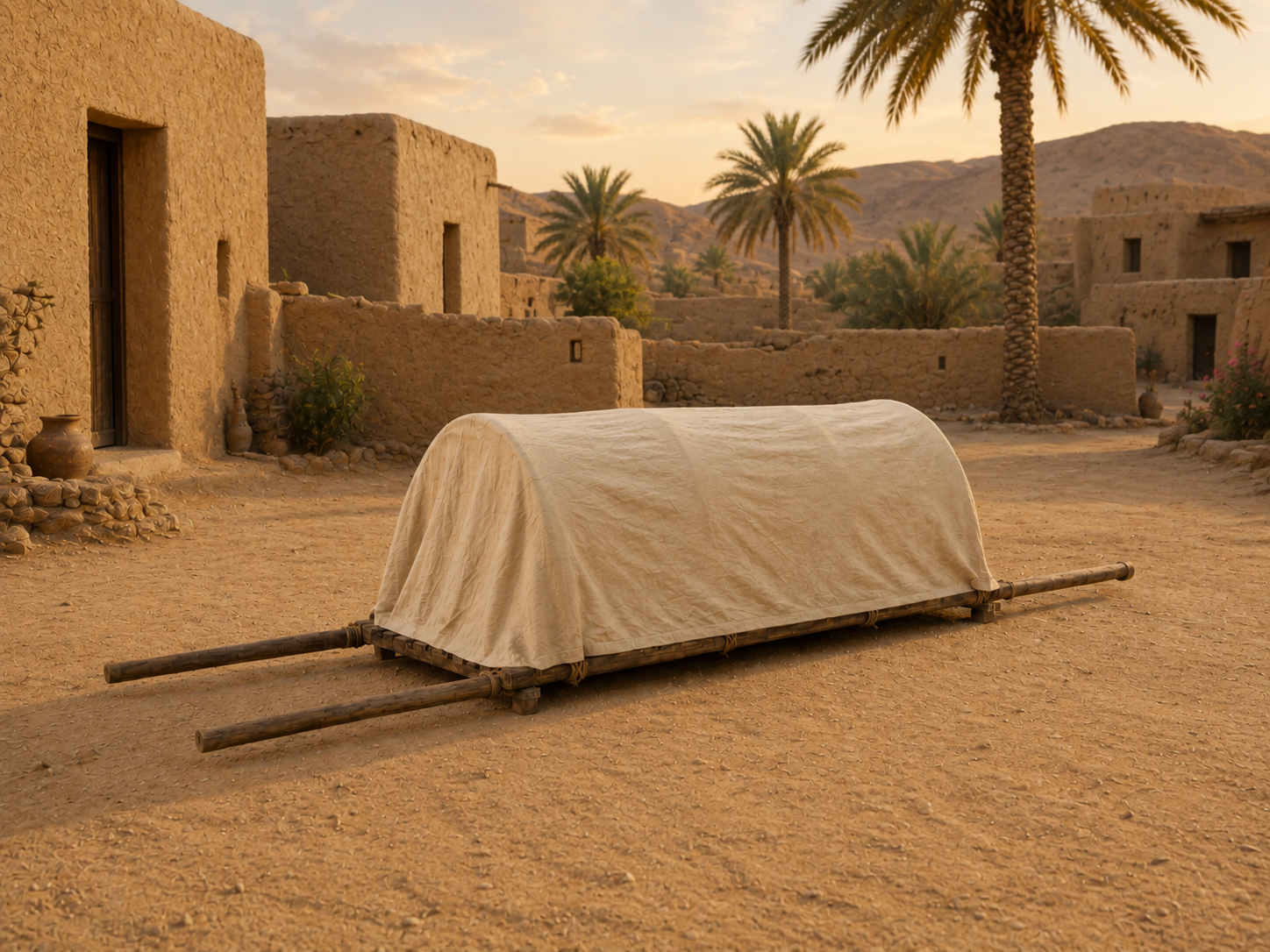
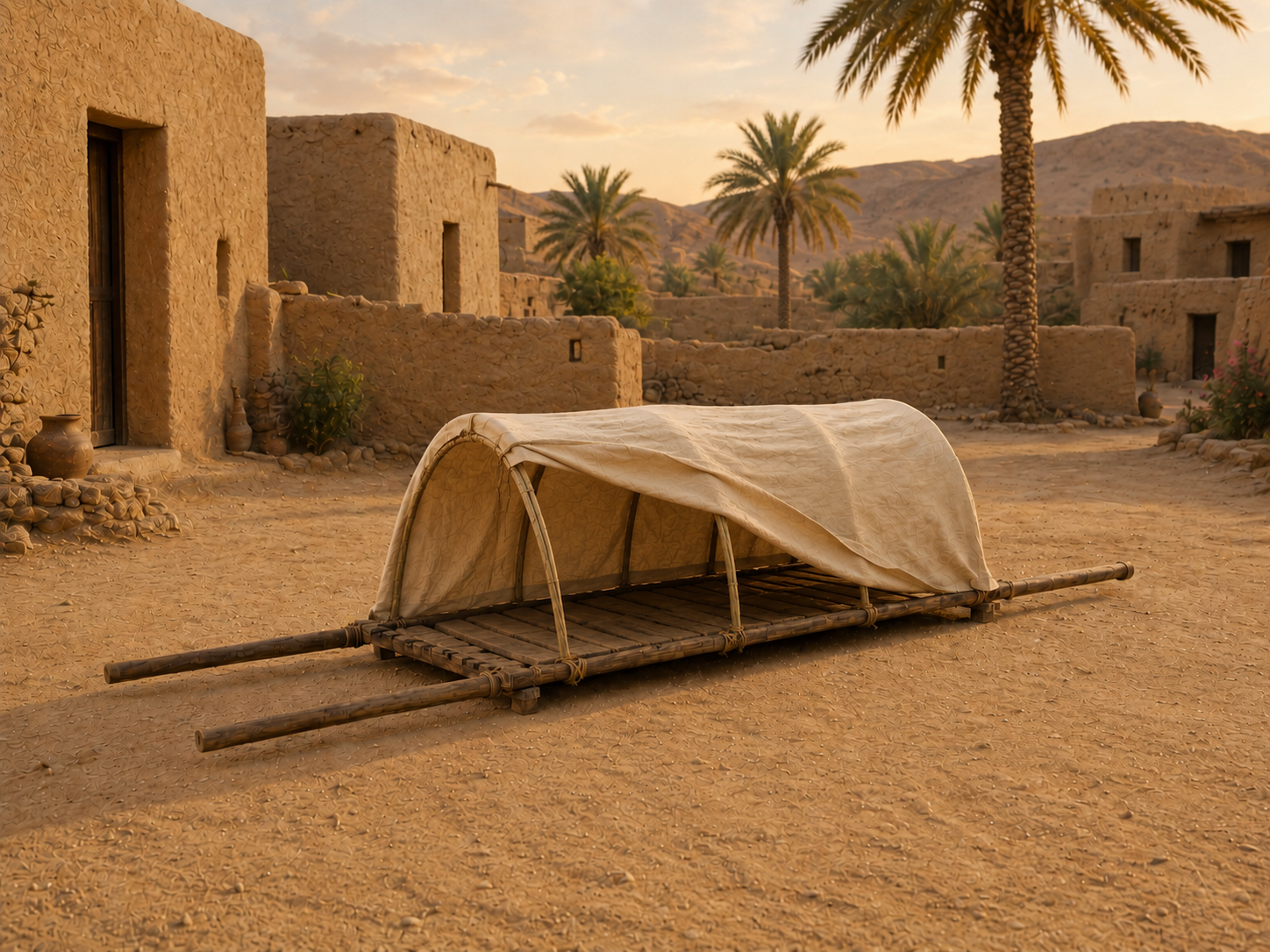
Artistic reconstruction based on classical accounts; exact dimensions are not recorded.
The wording preserved by al-Hakim in al-Mustadrak is particularly useful. It relates that Asma obtained fresh palm stalks and made a raised naʿsh upon the sarir, the carrying stretcher. This suggests that the covered structure was an addition to the ordinary stretcher rather than an elaborate permanent carriage.
Our reconstruction should therefore be understood in exactly that way: not as an archaeological reproduction of a surviving object, but as an attempt to visualise the simple construction described by the early historians.
When Sayyidah Fatimah (RA) saw what Asma had made, she was delighted by it.
The reports preserve her words:
How beautiful and excellent this is.Ibn ʿAbd al-Barr, al-Istiʿab fi Maʿrifat al-Ashab; al-Hakim, al-Mustadrak ʿala al-Sahihayn
Another report states that she smiled when she saw the arrangement and that Asma had not seen her smile in this way since the passing of Nabi Muhammad ﷺ.
The reason for her happiness was simple: the new covering achieved exactly what she had wanted. Her body could be carried with complete dignity and the cloth would no longer rest directly upon her form.
The story is a beautiful reflection of the haya and modesty of Sayyidah Fatimah al-Zahra (RA). Her concern for concealment did not end with her life; even in her final illness she was thinking about how she would be carried after death.
The reports further relate that she instructed Asma that when she died, Asma and Sayyidina ʿAli ibn Abi Talib (RA) should attend to her washing and that others should not enter upon her. Classical Sunni biographical works preserve the account that ʿAli and Asma subsequently washed her.
She was then buried quietly during the night, in accordance with the well-known traditions concerning her final wishes.
The best-known classical tradition identifies Sayyidah Fatimah al-Zahra (RA) as the first Muslim woman whose funeral stretcher was covered in this manner.
Ibn ʿAbd al-Barr states explicitly:
Fatimah was the first woman in Islam whose funeral stretcher was covered in this manner; after her, Zaynab bint Jahsh was treated likewise.Ibn ʿAbd al-Barr, al-Istiʿab fi Maʿrifat al-Ashab
This statement was repeated by later scholars including Ibn al-Athir and al-Suyuti.
Ibn Saʿd likewise preserves the tradition that the covered stretcher was made for Sayyidah Fatimah by Asma bint ʿUmays, who had seen the practice in Abyssinia.
There are, however, other historical reports which associate the introduction of the covered stretcher with Umm al-Muʾminin Zaynab bint Jahsh (RA), who died during the caliphate of Sayyidina ʿUmar (RA). One such account similarly says that Asma described what she had seen in Abyssinia and that a raised covering was then made for Zaynab.
For that reason, it is better not to force the reports into an artificial reconciliation. The classical sources preserve more than one account, but Ibn ʿAbd al-Barr's well-known conclusion gives precedence to Sayyidah Fatimah and places Zaynab after her.
The significance of the story extends beyond the funeral of Sayyidah Fatimah herself.
Later scholars discussing the funeral of a woman referred to the desirability of placing a raised covering over her stretcher so that her body remained concealed. Classical and later works on funerals repeatedly refer back to the practice associated with Fatimah and Asma when explaining the purpose of such a covering.
It is striking how simple the original construction appears to have been. There was no elaborate carriage and no ornate structure. The account requires little more than an ordinary wooden stretcher, fresh flexible palm stalks bent above it, and cloth placed over the top.
The idea itself had been seen in Abyssinia. Asma remembered it years later in Madinah and showed it to the daughter of Nabi Muhammad ﷺ. Sayyidah Fatimah recognised immediately how well it served the modesty she desired.
That small exchange between two remarkable women became one of the most memorable details preserved from the final days of Sayyidah Fatimah al-Zahra (RA).
The daughter of Nabi Muhammad ﷺ, already known throughout her life for her haya, wished to leave this world with that same concealment. And so, when she was eventually carried into the Madinah night, the cloth above her did not reveal the form beneath it. It rested instead upon the simple raised covering that Asma bint ʿUmays had remembered from Abyssinia.