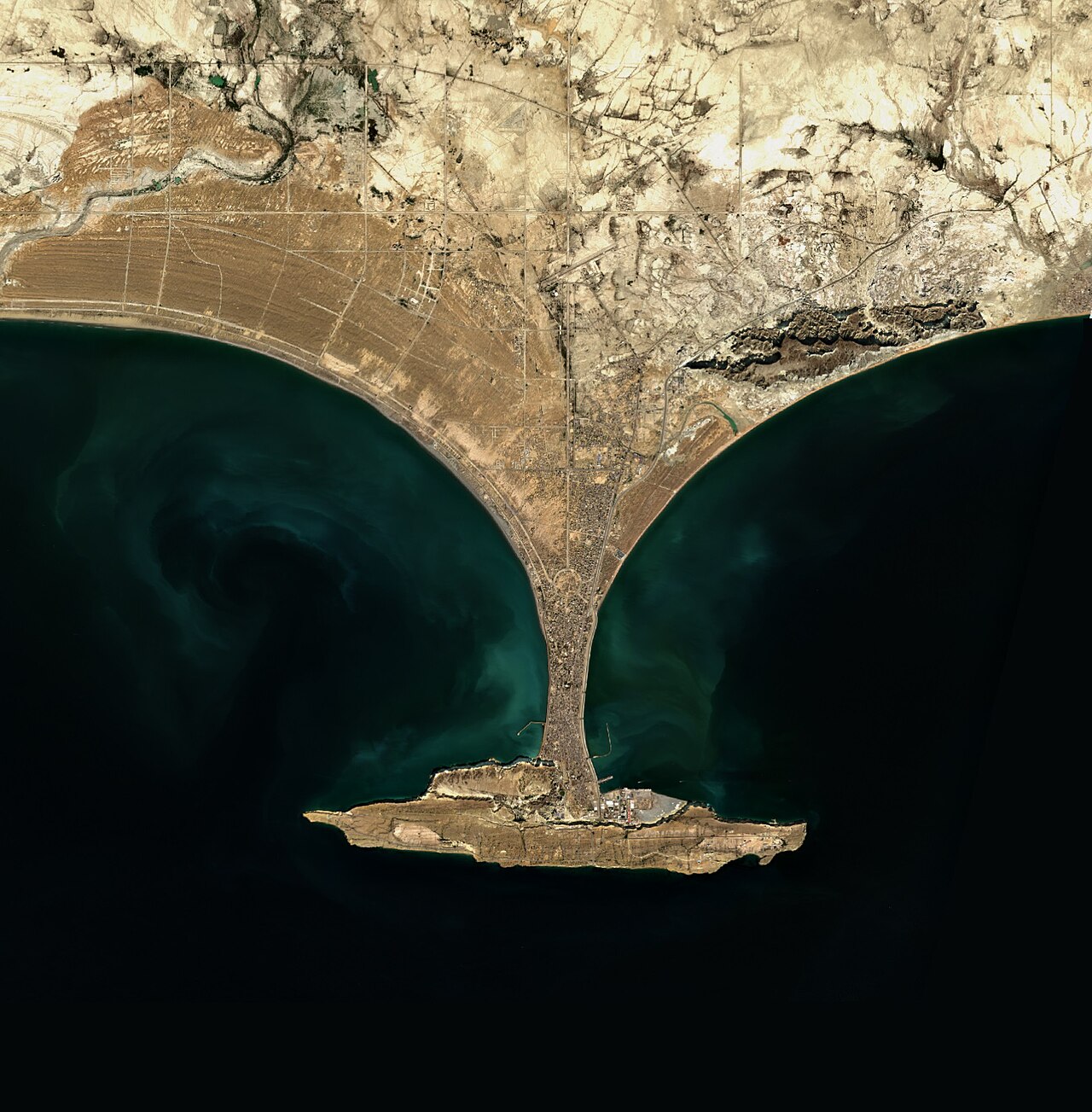
How did Pakistan buy Gwadar, a town on its own coast? The story of Omani Gwadar from 1783 to 1958, why the port mattered, and what Pakistan paid.
Gwadar lies on Pakistan's Makran coast in Balochistan, so many people are surprised to hear that Pakistan bought it in 1958. How can a country buy a town on its own coastline? The answer is that for about 175 years Gwadar did not belong to the land around it. It belonged to the Sultan of Oman, on the other side of the Arabian Sea.12
The story begins with a quarrel in the ruling family of Oman. In 1783 an Omani prince, Sultan bin Ahmad, arrived on the Makran coast after a failed attempt to take power in Muscat. Nasir Khan, the Khan of Kalat, gave him refuge and let him have Gwadar, then only a small fishing village, together with a share of its revenue for his upkeep.34
In 1792 the prince became Sultan of Oman, but he did not return Gwadar. What had begun as a temporary arrangement became permanent as Oman tightened its hold.3 The Sultans ruled the town through their own governor, the wali, built forts there, and in the nineteenth century the British brought the telegraph to the town.5
The Khans of Kalat never accepted this. They held that the grant had only been for the prince's upkeep while he was a refugee in Makran.4 More than once they asked for Gwadar back, but the British, who protected Oman, would not support the claim.31

When Pakistan gained independence in 1947, Gwadar stayed with Oman. In March 1948 the states of the region, including Makran and Kalat, acceded to Pakistan, which left Gwadar as a small pocket of Omani territory with Pakistan all around it.5 From 1948 Pakistan worked to bring it in, its case being that Gwadar had historically been part of Kalat, which was now part of Pakistan.6
Pakistan also had a strong economic reason. Gwadar's potential as a deep-water seaport was first noted in 1954, while the town was still under Omani rule.7 It sits on a natural hammerhead-shaped peninsula with deep water beside it, at the gates of the Strait of Hormuz, the only passage by which the oil and gas of the Gulf reach the open ocean.78 It is also the nearest warm-water seaport to Afghanistan and the landlocked countries of Central Asia.7
A port there could give Pakistan a second great gateway to the sea alongside Karachi, close to the world's busiest oil routes. It promised trade, shipping income, jobs and new industry, and the chance for Pakistan to become the route by which its landlocked neighbours reach the ocean. That promise began to be realised decades later, when the modern port was opened in 2007.7
The talks were slow. The Sultan, Said bin Taimur, was a tough negotiator and would not deal with Pakistan directly, so the British acted as intermediaries.3 The Prime Minister, Feroz Khan Noon, believed Pakistan had a strong legal case: in his view Gwadar had been a jagir, a grant of revenue that never gave full ownership and could have been cancelled without payment. Pakistan nonetheless chose to reach a settlement by agreement.36 His wife, Begum Viqar-un-Nisa Noon, helped by lobbying for the transfer in London in 1956.9
Under the agreement, Pakistan paid Oman compensation for the income Oman would lose from Gwadar, and the wording was chosen so that the Sultan did not technically "sell" the town. Pakistan also agreed to give Oman 10 percent of the profits from any oil found at Gwadar for 25 years.6 On 8 September 1958 the administration of Gwadar passed to Pakistan, and on 8 December 1958 it officially became part of Pakistan.2
The sum in the agreement was three million pounds sterling, as recorded from the agreement itself and by the historian of Oman J. E. Peterson.610 At the fixed exchange rate of 1958, £3 million was $8.4 million, the figure Dawn gives for what Pakistan paid, and about 4 crore rupees.111213 Adjusted for inflation, $8.4 million in 1958 is worth about $98 million today.1415
Some accounts give the price as three million US dollars, and much larger figures such as "Rs 5.5 billion" or "$1.15 billion" are also repeated online.1 The last of these is simply Rs 5.5 billion converted at the 1958 rate of 4.76 rupees to the dollar, and it is around 140 times the sum named in the agreement.
Both answers hold some truth. In law, Gwadar in 1958 was Omani territory, so Pakistan had to reach an agreement with Oman and pay. In Pakistan's eyes, though, it was recovering a town that had once belonged to Kalat and had been lent to a guest nearly two centuries earlier. That is why the payment was framed as compensation for Oman's lost income rather than as a straightforward sale.6
The Omani years are still visible in the town. Three forts were built during Omani rule, and thousands of people in Gwadar hold both Pakistani and Omani nationality and live and work between the two countries.16